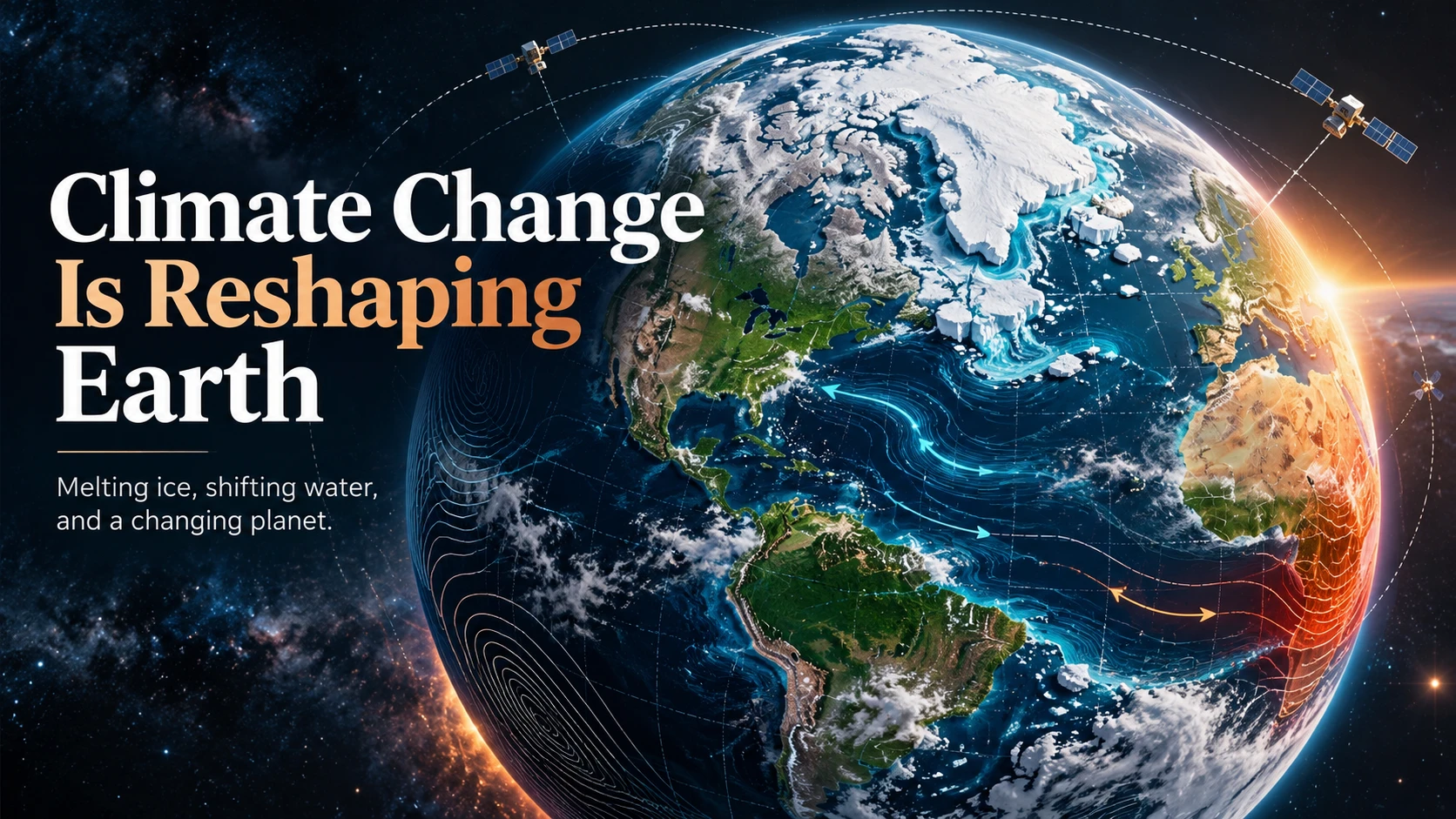
A new scientific study reveals how melting ice, moving water, and a changing climate are subtly altering Earth’s shape.
An original reflection on recent reporting and peer-reviewed research • October 25, 2026
For years, we have discussed climate change in terms of rising temperatures, collapsing ice shelves, extreme weather, and the struggle of communities to adapt. But a remarkable new scientific finding invites us to consider something even more fundamental: the physical shape of the planet itself is changing.
On October 22, 2026, Live Science published an article by Stephanie Pappas titled “Climate change is literally altering the shape of our planet.” The article highlights research showing that Earth’s solid surface has been becoming slightly less flattened at the poles and less bulging around the equator. In other words, the solid Earth is becoming a little rounder.
That is an extraordinary idea to sit with. We are not merely changing what happens on Earth. Through warming, ice loss, and the movement of water, humanity is contributing to changes in the planet’s physical geometry. And scientists can measure them.
Earth Was Never a Perfect Sphere
If you were taught that Earth is round, that was a useful starting point—but it is not the entire picture. Because our planet rotates, it is naturally a little wider around the equator and slightly flattened at the poles. Scientists call this an oblate shape.
The difference is enormous compared with the tiny changes scientists are now tracing. No one standing outside will see the planet suddenly reshape itself. These are millimeter-scale changes occurring across an immense world. What makes them important is not their visual drama but what they tell us about forces acting on the Earth system.
The New Research: What the Measurements Show
The study, published on September 9, 2026, in the Journal of Geophysical Research: Solid Earth, was conducted by geodesy researcher Christoforos Kotsakis of Aristotle University of Thessaloniki. Geodesy is the science of precisely measuring Earth’s size, shape, gravity, and movement.
Kotsakis analyzed vertical ground motions recorded through Global Navigation Satellite Systems, or GNSS—the wider family of satellite-positioning systems that includes GPS. Rather than trying to judge Earth’s outline from photographs, the research used exceptionally precise information about whether parts of the solid surface were moving upward or downward.
The analysis covered observations from 1997 through 2015. It found that the large-scale average rate of polar uplift grew from about 0.5 millimeters per year in 1997–2000 to nearly 1 millimeter per year in 2011–2015. At the same time, equatorial regions showed a corresponding large-scale tendency toward downward movement. The study estimates an accelerating reduction in the flattening of the solid Earth, on the order of 0.4 millimeters per year per decade.
These figures are tiny in everyday terms. But in planetary science, a persistent change measured across continents is meaningful, especially when it connects with independent observations of disappearing land ice and shifting water mass.
Why Melting Ice Can Move Solid Rock
Think of a heavy weight pressing into a cushion. Remove that weight and the cushion rises. Earth’s crust and underlying mantle are much more complicated than a cushion, of course, but the basic principle helps explain part of the story.
Huge ice sheets exert tremendous pressure on the rock beneath them. When they lose mass, that loading changes. The solid Earth responds, sometimes through relatively rapid elastic deformation and sometimes through very slow adjustment connected with ice lost thousands of years ago. Scientists refer to that longer-term process as glacial isostatic adjustment.
Meanwhile, water formerly stored on land flows into the oceans, redistributing mass across the globe. The new study indicates that today’s ice loss and mass redistribution contribute to the changes in the solid Earth’s shape beyond what would be expected from ancient glacial adjustment alone.
This is one reason the climate emergency cannot be understood as a problem affecting only air temperature. Ice, water, gravity, rock, and planetary rotation are linked. Change one part of the system and other parts respond.
An Important Scientific Distinction: “Rounder” Depends on What We Measure
There is an important detail in the research that deserves more attention than a dramatic headline can provide.
When scientists study the geometry of the solid Earth—the rock surface beneath land and oceans—the measured trend indicates less flattening. The poles are rising relative to the broader planetary pattern, while the equatorial bulge of the solid surface is diminishing.
But when we consider where mass is moving, including water accumulating at lower latitudes, a different measure can show increasing equatorial concentration. The shape of the solid surface and the shape inferred from Earth’s gravity field are related, but they are not identical. The research explains why both trends can be true at the same time.
That distinction matters. Responsible climate communication should help readers understand the science, not turn every surprising discovery into an oversimplified claim.
A Changing Planet Is Already Visible in Other Measurements
The new findings fit into a wider picture of a physically changing Earth. NASA’s GRACE and GRACE Follow-On satellite missions have tracked losses from the Greenland and Antarctic ice sheets since 2002. NASA’s published measurements for the 2002–2025 period indicate average annual losses of roughly 264 billion metric tons of ice from Greenland and 135 billion metric tons from Antarctica.
Other NASA-supported research has found that changes in the location of ice and water are influencing Earth’s spin axis and making days very slightly longer. These changes are minute; they do not mean clocks need to be adjusted because a day has suddenly become noticeably longer. They are powerful because precise science can detect an Earth-system response that human senses cannot.
Ice loss also affects coastlines unevenly. As an ice sheet loses mass, its gravitational pull on nearby seawater changes, producing regional patterns in sea-level rise sometimes called sea-level “fingerprints.” The people facing higher tides, saltwater intrusion, or repeated flooding experience the consequences locally, even when the causes are planetary.
What This Study Does—and Does Not—Tell Us
This study strengthens our understanding of how ice loss and changing surface loads influence Earth’s global geometry. It does not establish that the world is undergoing a sudden change of shape, and it does not mean the millimeter-scale adjustment itself is an immediate disaster.
It is also important to note that although the scientific paper was published in 2026, the satellite-positioning measurements examined in this analysis extend through 2015. The researchers acknowledge uncertainty associated with uneven monitoring-station coverage, how observations are interpolated across the planet, and assumptions about how the solid Earth responds to changing loads.
Those caveats do not erase the finding. They tell us where the evidence is strongest and where continued measurement can sharpen the picture. Climate literacy means making room for both urgency and precision.
Why This Matters to Our Communities
My reaction to this news is a mixture of awe and responsibility. The same human choices that shape energy systems, transportation, agriculture, and land use are also contributing to changes that sophisticated instruments can detect in the planet’s physical structure.
That should make our conversations about climate action more serious, but it should also make them more inclusive. Communities should not need an advanced degree in geophysics to understand why the climate emergency affects water security, infrastructure, food systems, housing, and local resilience.
I believe we need to bring reliable scientific information into ordinary places: homes, classrooms, libraries, community centers, towns, villages, and online learning spaces. We should ask better questions, examine original sources, help one another understand uncertainty, and connect scientific knowledge with practical decisions.
This discovery is an invitation to learn how systems are connected—and then use that understanding. Cutting heat-trapping emissions, protecting and restoring ecosystems, investing in sound adaptation, and insisting on evidence-based public policy are not competing priorities. They are parts of a larger responsibility to one another and to the living world.
The Planet Is Responding. Will We?
There is something profound about knowing that a warming world is not only losing ice or gaining ocean water, but also undergoing measurable adjustments in its solid form. Earth is not a static stage on which human history unfolds. It is a dynamic system that responds to what happens upon it.
The message I take from this research is not that we should panic over a millimeter. It is that we should recognize what a millimeter can reveal. Tiny measurements, repeated and carefully tested, can expose changes of enormous significance.
If we can measure the planet responding to our actions, surely we can also choose actions that are more informed, compassionate, and responsible.
Please read the original reporting and, if you want to go deeper, the scientific study itself. Share them with someone who believes the climate emergency is abstract or far away. The evidence is written not only in thermometers and ocean records, but now also in the changing geometry of the ground beneath us.
Sources and Further Reading
NASA — Ice Sheets: Earth Indicator (2002–2025 observations)
NASA/JPL — NASA-Funded Studies Explain How Climate Is Changing Earth’s Rotation (July 19, 2024)
NASA — Evidence of Sea Level “Fingerprints”
Editorial note: This post is original commentary and explanation. It credits and links to the reporting and research; no copyrighted article text or images have been reproduced.