This is a different version than the one I posted to my PERSONAL SITE… it is the original draft version…
An election-season reflection on political conscience, public responsibility, and the person each of us is choosing to become.
October 26, 2026 | Mr. Alvarez
I have been thinking about something that rarely receives enough attention during an election: not just what candidates ask us to believe, but what they ask us to become.
Every campaign tells a story. Some stories invite us to solve problems together. Others invite us to look at our neighbors with suspicion, to laugh at another person’s suffering, or to accept the humiliation of someone we have never met as the price of winning. The message may arrive as a television advertisement, a campaign speech, a political cartoon, a text message, or a short video that travels across social media before anyone checks whether it is true.
My concern is not that people disagree. We are supposed to disagree in a free society. My concern is the moment a disagreement about public policy turns into a campaign against someone’s basic humanity. The moment race, religion, ancestry, family tragedy, or personal identity is presented as a reason to fear a person rather than evaluate their ideas, something important has been abandoned.
I cannot know every candidate’s private intentions. But I can examine the choices that are made in public. The words we select, the claims we repeat, and the cruelty we excuse all reveal something about our judgment. That observation applies to Democrats, Republicans, independents, and the rest of us. If a principle protects only people on my side, I have not yet made it a principle.
A Vote Should Be an Argument for Something, Not an Invitation to Hate Someone
There is a serious difference between a difficult accusation and a degrading one. We should question a candidate about public spending, conflicts of interest, voting history, law enforcement, immigration, schools, healthcare, civil rights, foreign policy, and every other matter that affects our lives. If someone has lied, abused power, or harmed the public, the evidence belongs in the conversation. Accountability is not cruelty simply because it feels uncomfortable.
But there is no public-policy explanation for treating an entire religious community as suspicious. A disagreement about immigration law does not make immigrants less human. Disagreement over a nation’s government does not justify hostility toward people who share a religion or heritage associated with that nation. Criticizing a candidate’s record does not require turning childhood suffering into entertainment.
Here is the question I wish more of us would ask when a campaign message lands on our phones: What am I actually being asked to judge? The candidate’s actions and proposals—or a manufactured picture of someone I am supposed to despise?
Fear can be politically useful because it simplifies complicated situations. Instead of asking what a proposal costs, how it works, and whom it helps, the message offers an enemy. Instead of making room for uncertainty, it offers certainty without evidence. Instead of convincing us, it may try to provoke us. Once we are angry enough, we can mistake the intensity of a feeling for the accuracy of a fact.
That is how division becomes more than a slogan. It becomes a habit of mind. We learn to hear a person’s name and imagine a threat. We begin defending conduct from our preferred group that we would immediately condemn if another group had done it. We become less curious, more easily manipulated, and less willing to recognize the humanity of a neighbor.
I do not believe this is the kind of personal transformation we should be pursuing.
The 2026 Midterms Offer a Test of Conscience, Not Just Political Loyalty
The November 3, 2026, midterm elections are approaching as I write this, and recent reporting shows how these choices are playing out in real time. I do not raise these examples to instruct anyone which party to join or which candidate to support. I raise them because a nonpartisan standard is not meaningful unless we are willing to apply it to actual conduct.
On October 25, at a campaign rally in Port Huron, Michigan, President Donald Trump described Democratic U.S. Senate candidate Abdul El-Sayed as a “jihadist” and suggested he would need to pass through a metal detector to enter the Senate. The Associated Press reported that Trump portrayed El-Sayed, who is Muslim, as a national-security threat, and that there was no evidence connecting El-Sayed to the Muslim Brotherhood despite allegations made against him. The Associated Press documented the statements and their context.
El-Sayed’s policy proposals, public statements, political associations, and past mistakes are all legitimate subjects for scrutiny. The same reporting described criticism he received for remarks after an attack on a synagogue, for which he later apologized. None of that removes the obligation to distinguish documented conduct from unsupported allegations or religious suspicion. One form of accountability should not require abandoning another.
What struck me most was a response from Bishara Bahbah, who helped organize Arab American support for Trump in 2024. Bahbah criticized the president’s remarks as racist. Here was someone who had supported the politician publicly refusing to defend a particular line of attack. That is a form of independence worth paying attention to: the ability to say, “I supported you, but I will not excuse this.”
Another Michigan controversy arose from a separate political action committee’s advertisement supportive of El-Sayed. It linked Americans’ grocery costs to support for Israel, drawing criticism over misinformation and what critics saw as antisemitic themes. El-Sayed’s campaign disavowed the advertisement and said it was unaffiliated. I think the distinction is essential: an independent group’s message should not automatically be attributed to a candidate who rejects it. But we should examine the message on its merits. Debate over U.S. foreign policy and Israeli government actions is legitimate; suggesting that a people or nation supplies a convenient explanation for every household hardship deserves closer examination, not automatic applause.
In Ohio, another example of the limits of political attack came from the gubernatorial campaign. Republican nominee Vivek Ramaswamy’s campaign produced an advertisement featuring the estranged mother of his Democratic opponent, Amy Acton, making personal accusations against her. The attack became especially controversial because Acton had publicly discussed traumatic childhood experiences and a long-standing family estrangement. Republican Sen. Jon Husted said he would not have run the advertisement; Republican Gov. Mike DeWine also called for it to be withdrawn. Vice President JD Vance defended it. Associated Press reporting describes these disagreements.
Notice what these examples reveal. People within political coalitions can draw different moral lines. Some consider a tactic justified because an election is close or a candidate has become a symbol of everything they oppose. Others recognize that the method itself is part of the candidate’s public record. A campaign does not become above criticism because its intended goal is popular with its supporters.
I do not yet know who will win these races. Neither do the voters who must decide. But I do know that victory, if it comes, will not retroactively make an unsupported accusation true or a humiliating tactic honorable.
A Lesson From 1898: The Danger of Pretending That Hate Is Only Theater
It would be comforting to say that racism and intimidation always defeat themselves. Unfortunately, American history does not permit such an easy conclusion.
In Wilmington, North Carolina, in 1898, white supremacist Democrats carried out a campaign of propaganda and intimidation against a multiracial political coalition associated with Republicans and Populists. The campaign culminated on November 10 in a violent overthrow of the city government. Black residents were killed, the office of a Black-owned newspaper was destroyed, and officials were forced from power. North Carolina’s own Department of Natural and Cultural Resources documents the coup and its aftermath. Restrictions on Black voting followed.
It matters to name the historical party affiliations correctly. It also matters not to pretend that party identities and political coalitions from the nineteenth century can be transferred unchanged to today’s electoral map. History should help us understand what happened, not become another prop for present-day tribal combat.
Wilmington was not simply an ugly advertisement that voters rejected. It was a case in which organized racial fear contributed to the destruction of democratic government and to real, lasting harm. I would never equate every inflammatory modern campaign message with that violent coup. Scale and circumstances matter. But I also refuse to believe that dehumanizing language is always harmless because someone describes it as politics.
A message can be effective and immoral at the same time. It can win applause and leave people less safe. It can help people gain power while making the public less free. If we judge a campaign only by whether it wins, we risk mistaking power for wisdom.
The Courage to Correct Our Own Side
Seventy-six years ago, Republican Senator Margaret Chase Smith stood in the Senate and offered a warning that remains strikingly contemporary. In her June 1, 1950, “Declaration of Conscience,” she criticized the Democratic administration of the time, yet argued that Republicans should not seek victory through what she called the “Four Horsemen of Calumny—Fear, Ignorance, Bigotry, and Smear.” Her speech is preserved by the United States Senate.
Smith did not abandon her party or cease believing in its policy positions. Her message was more demanding than that: if my side has a legitimate case, why would it need dishonest or degrading methods to make it?
I find something deeply persuasive in a person willing to disagree with an ally in public. It is easy to be principled when the cost falls on one’s opponent. Character becomes visible when the cost is personal—when speaking clearly might offend friends, reduce one’s standing, or disappoint the people who usually cheer.
Four years later, during the televised Army-McCarthy hearings, attorney Joseph Welch confronted Senator Joseph McCarthy’s attack on a young lawyer. “Have you no sense of decency, sir?” Welch asked. The Senate’s historical account explains how the confrontation helped expose the senator’s tactics before the nation. McCarthy was subsequently censured by the Senate.
Those moments are remembered not because their participants offered a new economic program or solved every disagreement. They are remembered because someone insisted that the method of political struggle mattered. A cause does not become stronger by treating evidence as optional or cruelty as courage.
I think of that whenever I hear the defense, “This is just how politics works.” Politics is made by people. We are allowed to ask it to work differently.
What Happens When a Political Attack Boomerangs?
There is also a practical reason for campaigns to consider their methods. A voter watching a cruel advertisement receives two messages: a claim about the person being attacked and a demonstration of the judgment of the person delivering the attack. The second message is not necessarily the one the campaign meant to send.
Political scientists Vincenzo Galasso, Tommaso Nannicini, and Salvatore Nunnari examined negative campaigning in a field experiment during an Italian mayoral election, alongside a survey experiment. Their study, “Positive Spillovers from Negative Campaigning,” found that a negative message could harm the attacker and benefit another candidate who had stayed out of the exchange. Voters also perceived the attacker as less cooperative and less able to lead effectively.
That is interesting, but I would not stretch the finding into a promise that cruelty always loses. The experiment took place in particular electoral conditions, and negative campaigning covers many kinds of messages. A well-supported criticism of corruption is not the same thing as a racial slur. Nor does one experiment tell us how every American voter will respond to every advertisement in 2026.
The more important lesson is that we are always being told something about the speaker. Perhaps a harsh attack persuades one voter and alienates another. Perhaps it mobilizes an existing base while making cooperation afterward harder. Perhaps it works in the short term but damages a reputation over the long term. We should be able to hold more than one possibility in mind.
A broader research review points toward another cost. A meta-analysis published in *Human Communication Research*, drawing on 35 experimental studies, found a small negative overall effect of political incivility on political trust, but no overall effect on participation. In other words, research supports concern about public trust; it does not justify claiming that rude politics automatically makes everyone stop voting.
This distinction matters to me. I do not want to answer exaggerated campaign claims with exaggerated claims of my own. If I am asking others to respect truth, I have to respect the limits of the evidence I use.
The Cost Falls on People Who Never Asked to Be Targets
Public arguments do not remain neatly confined to campaign stages. They reach people standing in lines, working in election offices, teaching in classrooms, and trying to raise families. A neighbor may hear themselves described as a threat because of how they worship. A child may watch adults mock a stranger’s childhood pain. A public servant may become an object of suspicion because someone needs a villain for a political story.
The Brennan Center for Justice’s 2026 survey of local election officials is sobering. Among 834 respondents, 32 percent said they had experienced threats, harassment, or abuse connected to their work, while 52 percent expressed concern about the safety of colleagues or staff. Those figures do not show that any one speech or advertisement caused a particular threat. They do show that the people doing the ordinary work of democracy have reason to worry about the climate around them.
When I think of an election worker, I do not picture a party symbol. I picture a person checking voter registrations, answering questions, keeping equipment functioning, and hoping to go home safely. Political disagreement should be intense enough to hold institutions accountable but never so reckless that ordinary participation in public life becomes something to fear.
Technology adds another concern. In 2026, Reuters reported on AI-generated political deepfakes that can put invented words and actions in a candidate’s mouth. A manufactured image or recording may travel widely before a correction catches up. Whatever political position we hold, we should want the public to distinguish what happened from what a computer was instructed to make appear real.
I use technology and appreciate what it can make possible. But the ability to create a convincing image is not permission to fabricate a person’s character. The responsibility to verify, attribute, and correct becomes more important as our tools become more powerful.
The Quotation I Could Not Get Out of My Mind
A sentence kept returning to me as I thought about this subject: “Honest people don’t hide their deeds.” I initially remembered the words without knowing where they came from. Looking more closely, I found them in Emily Brontë’s 1847 novel Wuthering Heights, spoken by the character Nelly Dean while questioning Heathcliff’s conduct. The passage can be read in the full original text at Project Gutenberg.
I am glad to know their source. Yet the sentence also deserves to be examined rather than treated as a complete rule. Privacy is not dishonesty. People conceal personal information for good reasons: safety, dignity, the protection of children, or the right to have a private life. And some people display cruelty openly, with cameras running and supporters applauding. Being visible is not the same as being accountable.
What I take from Brontë’s line is a challenge about responsibility for our conduct. Can we explain what we did truthfully? Would we defend the same action if our opponent had done it? Are we willing to correct ourselves when the facts change? Can our political methods survive honest examination without requiring that we first strip someone else of dignity?
There is a related thought in John 3:21 about truth coming into the light. Religious and nonreligious readers may understand that image differently, but the civic question is accessible to everyone: what happens when we place our conduct where it can be examined, and refuse to invent excuses for it?
That question does not belong only to candidates or campaign strategists. It belongs to me whenever I decide whether to circulate a political post, repeat an allegation, join in a joke, or remain silent when an ally crosses a line.
Self-Transformation Begins With What We Refuse to Excuse
I have written before about personal growth and self-transformation. Those ideas can sound distant from elections, as though improving one’s character were a private project unrelated to government. I have come to see the opposite. Our public choices are one of the clearest places where our personal values are tested.
Imagine a conversation at a family table. Someone shares a claim that makes an unpopular candidate look terrible. People laugh. The claim fits the group’s opinion perfectly. Then someone asks where the evidence came from. The room goes quiet. Is that person spoiling the conversation—or doing everyone a favor?
I would rather be the one who asks. I would also rather be corrected if I am the one who shared the claim. No one is immune to anger, confirmation bias, embarrassment, or the desire to belong. I certainly am not. But the possibility of making mistakes gives us a reason to build better habits, not a license to stop trying.
Before I pass along a political attack, I want to know whether its facts have been checked, whether the missing context changes its meaning, and whether the same standard would be acceptable if it were aimed at someone I love. I want to notice whether the message explains a policy or merely invites a reaction. And I want to become less interested in delivering a clever insult and more interested in understanding what will actually improve people’s lives.
That is not a demand for politeness at any price. Some truths must be spoken forcefully. Racism should be named. Intimidation should be confronted. Leaders who abuse power should be held accountable. Those who are targeted should not be required to remain perfectly calm in order to deserve protection. Compassion is not the same as giving harmful conduct a pass.
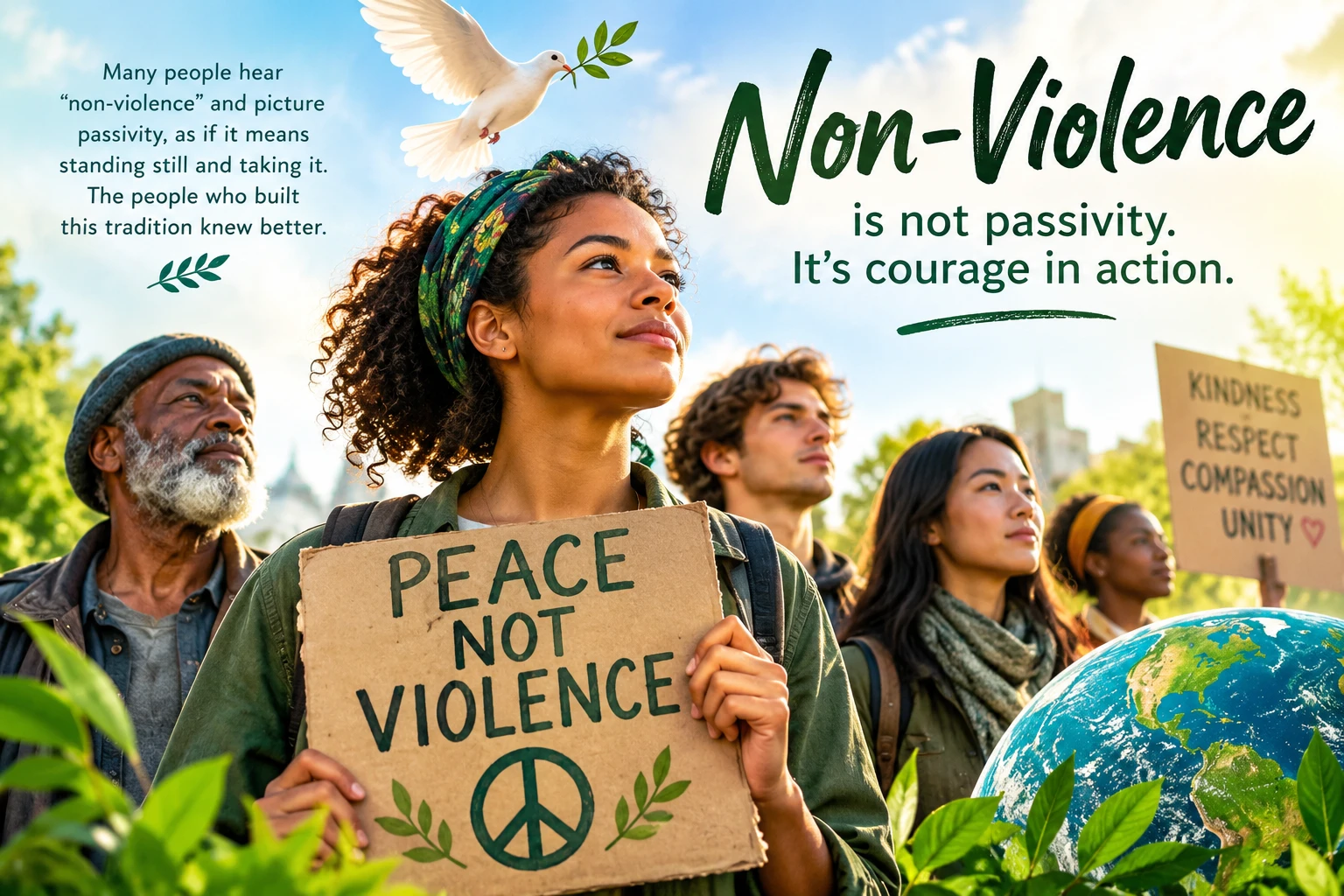
The late civil rights leader John Lewis understood that courage and nonviolence could exist together. Reflecting on his struggle in an interview, he described hate as a burden he did not want to carry and emphasized working against injustice rather than surrendering to hatred of other people. His reflections are preserved in a PBS interview. I find that distinction demanding, especially when public life makes contempt seem easy.
Not hating someone does not mean trusting them, agreeing with them, voting for them, or allowing harm to continue. It means refusing to let opposition remake us in the image of what we oppose.
This is where the idea of character comes back into focus. The opposite of cruelty is not weakness. It is the strength to stay truthful under pressure, the discipline to criticize without dehumanizing, and the willingness to hold our own allies accountable. It is the refusal to confuse a person with the political label attached to them.
The Message I Want My Vote—and My Voice—to Carry
I cannot predict the results of November 3, and I do not claim that an electorate will always punish racism, dishonesty, or cruelty. History shows otherwise. Research shows a more complicated picture than a simple story of inevitable backlash. But the possibility that an ugly tactic may work is precisely why we need standards that extend beyond electoral success.
A candidate can win without deserving every method used on the way to victory. A supporter can be right about a policy and wrong about how an opponent has been treated. An entire community can suffer when political leaders normalize suspicion and humiliation, even if those leaders eventually lose.
I want elections to involve difficult questions: Who can govern responsibly? Which proposals are realistic? Who tells the truth about costs and consequences? Who will protect rights, uphold the law, and treat people fairly even when they disagree? Those questions are substantial enough without dressing an opponent in the costume of an enemy.
Above all, I want to resist the habit of measuring people only by the party they belong to. We have families, workplaces, neighborhoods, and a shared future that continue after every ballot is counted. A republic depends on the possibility that neighbors can disagree without having to fear or despise one another.
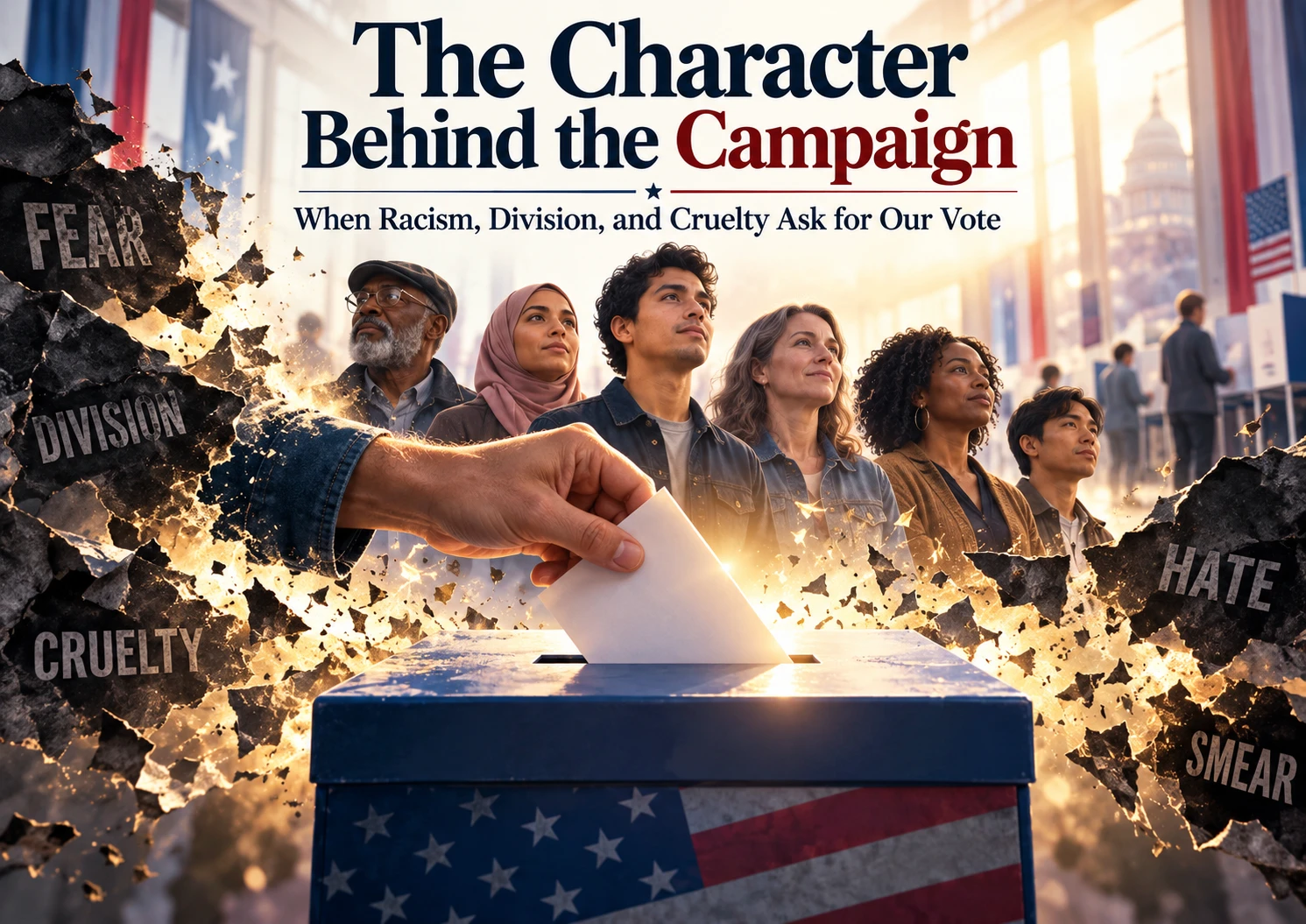
When a political message uses racism, division, cruelty, or hate, it does not establish the worthlessness of the people it targets. It tells us something about the judgment of those who choose to use it, defend it, or pass it along. Whether it also costs them votes is a separate question—one that evidence and election results must answer.
The deeper question is the one I began with: What kind of people are we becoming as we participate in all of this?
I would rather cast my vote with a clear conscience than allow someone else’s hunger for victory to decide the limits of my compassion. I would rather disagree with a neighbor honestly than be taught to fear that neighbor through a convenient falsehood. And I would rather live in a country where correcting one’s own side is recognized as integrity, not betrayal.
An election tells us who will hold office. The manner in which we conduct it tells us something about who we are.
We should care about both.
Source note: Contemporary examples and links were checked on October 26, 2026, before the November 3 midterm elections. This is a personal opinion essay, not an endorsement of any party or candidate. Reported events and published research are distinguished from the author’s interpretations and questions.