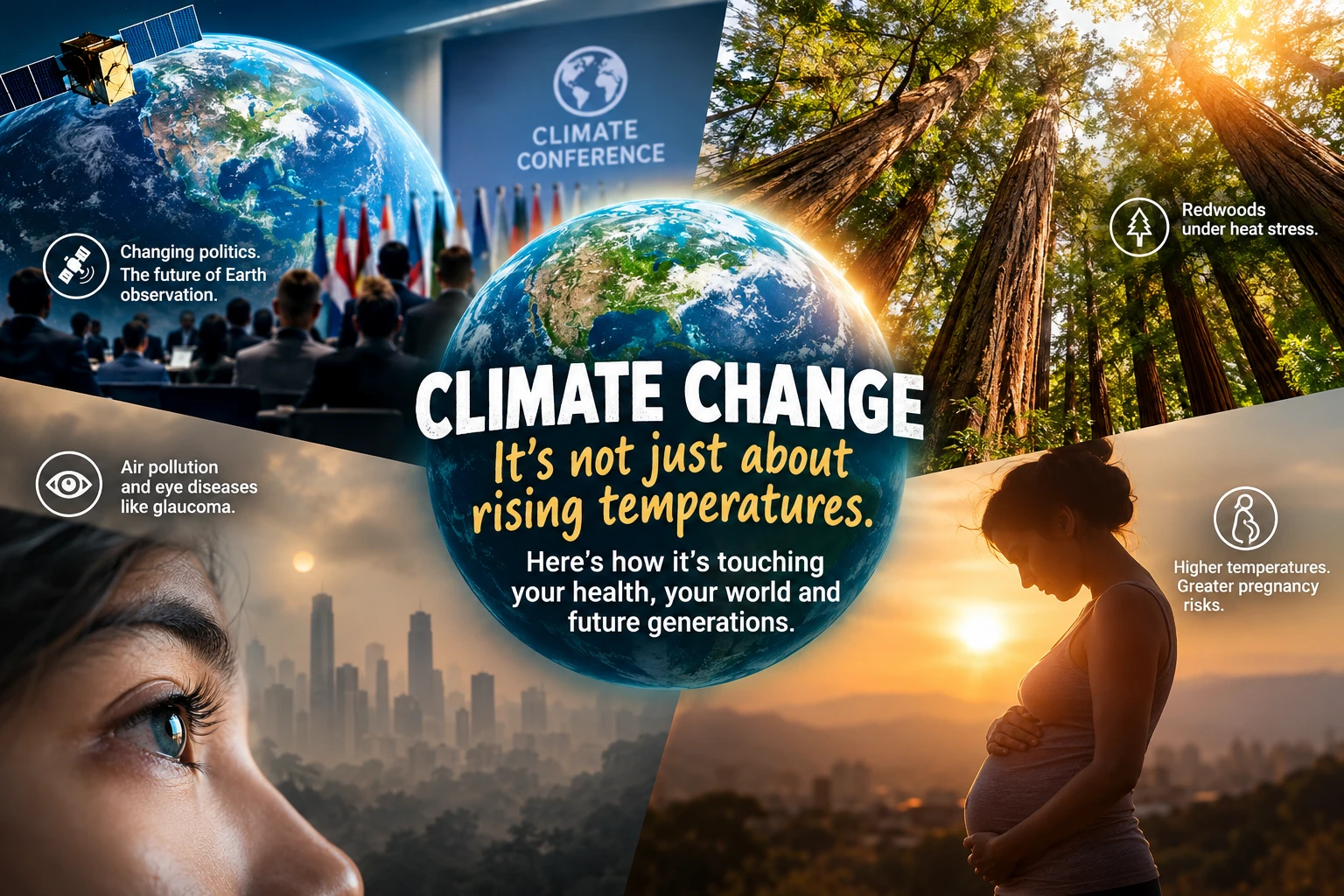
This article is in duplicated below after the source mentions for a younger generation to understand better.
Tropical forest carbon loss, rising seas, and the dangerous disappearance of “rare” climate events
Two disturbing reports reveal one deeper emergency: the living and physical systems that once absorbed climate pressure are becoming less reliable while communities are forced to absorb more of the consequences.
By Mr. Alvarez | Thoughts Enhanced by AI Assistant
|
The central argument This is not merely a story about forests and floods. It is a story about shrinking buffers: less ecological capacity to absorb carbon, less coastal margin before water crosses damaging thresholds, and less time for ecosystems and communities to recover between shocks. |
The two reports that sparked this article
Tropical forests stop absorbing carbon dioxide during El Niño events. This year could be the worst.
Two headlines, one destabilizing system
At first glance, these stories seem to occupy different worlds. One follows trees across tropical South America as heat and drought alter the balance between growth and death. The other follows tide gauges along the world’s coastlines as rising seas turn historically exceptional water levels into recurring disruptions.
But both stories describe the same structural change: climate pressure is consuming the safety margins that once kept disturbance from becoming disaster.
Tropical forests have removed and stored a portion of humanity’s carbon pollution. Coastal wetlands, dunes, reefs, floodplains, drainage systems and elevation have helped keep ordinary tides and storms below damaging thresholds. Neither protection was infinite. Both depended on background conditions remaining within a workable range.
As that range shifts, society faces a double exposure. Natural systems may provide less climate regulation, while homes, roads, utilities and institutions experience more frequent threshold crossings. We are losing buffering capacity at the same time we need more of it.
The forest finding: serious, but easy to overstate
The forest story is based on a 2023 Nature Climate Change study that examined 123 long-term forest plots in tropical South America. Before the 2015–2016 El Niño, the monitored forests accumulated an average of about 0.38 metric tons of carbon per hectare per year in aboveground biomass. Across the monitoring interval that captured the El Niño, the balance fell to roughly minus 0.02 metric tons per hectare per year—statistically indistinguishable from zero.
The main cause was not a measured collapse in tree growth. It was an increase in carbon loss through tree mortality. The forests continued adding biomass through growth and recruitment at about the previous rate, but more trees died, cancelling the sink.
That is an important distinction. The research does not prove that every tropical forest became a carbon source. It does not establish that the Amazon has already crossed an irreversible tipping point. It shows that a large, long-monitored network of intact forests ceased to function as a significant aboveground biomass carbon sink during an extreme climate anomaly.
The paper also contains a caution that alarming summaries can miss: although the 2015–2016 event was exceptionally hot and dry, the measured impacts in these intact forests were not demonstrably greater than the impacts of major South American droughts in 2005 and 2010. The science is alarming because the sink proved conditional—not because this single study proves immediate forest collapse.
A carbon sink is a living process, not a permanent machine
Calling a forest a carbon sink can make it sound like a fixed piece of climate equipment. In reality, a forest’s carbon balance emerges from competing biological processes: photosynthesis, respiration, growth, recruitment, mortality, decomposition and fire.
During hot and dry conditions, trees close leaf pores to conserve water. At the same time, atmospheric demand for moisture rises and water transport inside trees becomes more difficult. Large trees can be especially vulnerable because they must lift water farther and because they hold a disproportionate share of forest carbon.
When a large tree dies, its stored carbon does not all enter the atmosphere immediately. Some remains in standing or fallen wood and roots, then returns gradually through decomposition or rapidly if fire occurs. An extreme event can therefore weaken present-day carbon uptake while creating a delayed stream of future emissions.
This is why the loss of function can precede the visible loss of the forest. A canopy may remain on the landscape while carbon storage, drought resistance, rainfall recycling and biodiversity support are quietly degrading. Ecosystems can look present while becoming less capable.
The most vulnerable forests may be those with the smallest margin
The study found that forests with drier baseline climates were especially vulnerable. That matters because long exposure to seasonal drought does not necessarily mean unlimited adaptation. It may mean many trees are already operating nearer their physiological boundaries.
A modest additional temperature or moisture anomaly can then push mortality above growth. The problem is not only the size of the shock; it is the distance between normal operating conditions and a damaging threshold.
This is one of the deepest connections between the forest and coastal research. Risk accelerates when the baseline moves closer to the threshold. In a dry forest, a heat-and-drought anomaly can erase the carbon sink. On a coast, a few additional centimeters of mean sea level can allow an otherwise ordinary tide or storm surge to cross roads, drains and building foundations.
El Niño now arrives on top of human-caused warming
El Niño is a natural part of the climate system, but natural variability no longer operates on the climate of the nineteenth or twentieth century. Each event now unfolds in an atmosphere and ocean already warmed by greenhouse-gas emissions.
NOAA confirmed on June 11, 2026 that El Niño had formed and was expected to strengthen, with a 63% forecast probability that monitored Pacific temperatures would reach the agency’s “very strong” threshold. That forecast increases concern, but it is not proof that 2026 will produce the worst forest-carbon outcome ever observed. The first article’s warning is a risk statement, not a completed measurement.
This distinction is essential for credible climate communication. We should be forceful about demonstrated danger without turning a plausible severe outcome into a certainty. The real alarm is that another major climate stress test is occurring while many ecosystems are still carrying damage from previous heat, drought, fire and fragmentation.
The coastal finding: the baseline is rewriting probability
The second report concerns the changing frequency of extreme coastal water levels. A 2026 Nature Climate Change study combined long tide-gauge records with climate-model experiments designed to separate human influence from natural variability.
Its central finding is stark: globally, the median frequency of a coastal extreme that had been considered a one-in-100-year event in 1900 has increased about twelvefold. Human-driven radiative forcing alone quadrupled the likelihood of those events, and anthropogenic influence became dominant along most coastlines, especially from the late twentieth century onward.
A “100-year flood” does not mean a flood that occurs only once every century. It describes an event with about a 1% chance of occurring in any given year under the probability distribution being used. The concept becomes dangerously misleading when the underlying distribution is no longer stable.
Sea-level rise shifts the entire distribution upward. A storm does not need to become proportionally stronger for flooding to become much more frequent. The same tide, surge or wave begins from a higher platform. The water has less distance to travel before crossing the threshold that matters to people.
Why a few centimeters can transform daily life
Sea-level rise is usually communicated in centimeters or millimeters, while human consequences are experienced as thresholds: the elevation of a road, the height of a seawall, the outlet of a storm drain, the floor of a home, the salt tolerance of a wetland or the point at which an insurer decides a property is no longer acceptable risk.
That is why gradual physical change can feel sudden. A street may function for decades and then begin flooding during ordinary high tides. A drainage system may still be mechanically intact but unable to empty because the receiving water is too high. A household may survive one repair, then become financially trapped by repeated damage, higher premiums and declining property value.
The separate 2026 Science Advances study cited by Live Science found that human-caused sea-level rise was detectable at 97% of 519 tide-gauge sites and accounted for an estimated 58% of observed daily extreme-water-level exceedances from 2000 through 2018. That result moves the issue beyond future projection: human influence is already measurable in the water levels communities are experiencing.
Rare disasters becoming recurring conditions
A community may be able to recover from a devastating flood once in a generation. Recovery becomes fundamentally different when damaging water returns before mortgages, public finances, infrastructure and families have recovered from the previous event.
At that point, the hazard is no longer only an emergency-management problem. It becomes a chronic condition affecting commuting, school attendance, emergency access, business continuity, public health, insurance, municipal credit and the tax base.
The IPCC projects that, even by 2050, extreme sea levels that occurred about once per century in the recent past will occur annually or more often at roughly 19% to 31% of tide-gauge locations. Across locations, their median frequency is projected to increase about 20 to 30 times by mid-century. Emissions choices become even more consequential after 2050.
Calling this a “new normal” can be misleading. A normal is stable enough to plan around. The coastal baseline is still moving, and the rate of change after mid-century will depend strongly on emissions. We are not adapting to a single new climate; we are adapting while the target continues to move.
The direct connection: an El Niño “double whammy”
The two stories are connected through the long carbon-to-warming-to-sea-level chain, but the relationship is also immediate. NOAA warns that El Niño can temporarily elevate sea levels along the U.S. West Coast, shift storm tracks toward parts of the Mid-Atlantic and increase rainfall risks along portions of the Gulf and Southeast coasts.
Those temporary effects now arrive on top of decades of sea-level rise. NOAA oceanographer William Sweet describes the combination as a “double whammy”: the first punch is the higher background sea level; the second is an El Niño pattern that can add water or storminess in vulnerable places.
The same climate pattern can therefore stress tropical forests and worsen coastal flooding within the same broad period. One pressure weakens an ecological carbon buffer. Another pushes human settlements across physical thresholds. This is what compound climate risk looks like: multiple systems becoming more fragile at once, with interactions that cannot be understood by studying each hazard in isolation.
The deeper crisis is the loss of recovery time
Resilience is often imagined as the ability to bounce back. That idea assumes there is enough time between shocks to restore the previous condition.
But what happens when the next drought arrives before forests replace the large trees lost during the last one? What happens when another flood occurs before a household has rebuilt its savings, before a municipality has repaired its drainage network or before residents have recovered psychologically from displacement?
As recovery intervals shrink, resilience can become exhaustion. Systems begin each new disturbance with fewer reserves. Damage accumulates. Maintenance is deferred. Emergency spending crowds out prevention. Ecological and financial debt compound together.
The critical variable is therefore not only the intensity of each event. It is the relationship between disturbance frequency and recovery time. When disturbance outruns recovery, “bouncing back” becomes impossible and transformation becomes unavoidable.
From natural buffers to adaptation debt
When forests absorb less carbon, society must cut emissions faster—or remove more carbon elsewhere—to achieve the same temperature outcome. When wetlands, reefs and dunes are degraded, communities must spend more on walls, pumps and engineered drainage to replace services that living systems once provided.
When flooding becomes recurrent, public money is repeatedly spent repairing yesterday’s damage instead of preventing tomorrow’s. This is adaptation debt: the accumulating cost of delaying emissions reductions, ecosystem protection and resilient investment.
The debt is not shared equally. Wealthier households and communities often have greater access to insurance, legal assistance, political influence, private transportation and relocation options. Renters, low-income households, older adults, disabled people, Indigenous peoples and historically disinvested neighborhoods may face greater exposure with fewer choices.
A resilience strategy that protects high-value property while transferring risk, debt and displacement to people with less power is not resilience. It is climate inequality reinforced through infrastructure and finance.
Adaptive resiliency must mean more than enduring damage
A serious adaptive-resiliency response begins by rejecting the idea that communities should simply become better at absorbing repeated harm. Resilience must include the power to reduce exposure, change direction and leave unsafe arrangements behind.
First, protect the remaining natural buffers. Preventing deforestation and degradation, defending Indigenous land rights, restoring wetlands and floodplains, and allowing coastal ecosystems space to migrate can preserve carbon storage and reduce physical hazard. These actions complement—not replace—the rapid phaseout of fossil-fuel emissions.
Second, design for nonstationarity. Flood maps, building codes, drainage standards, insurance models and infrastructure finance should incorporate changing baselines, compound flooding and multiple future scenarios rather than treating the twentieth century as a permanent design manual.
Third, establish adaptation pathways with trigger points. Communities need pre-agreed signals for when to elevate, protect, restore, restrict new development or begin managed retreat. Waiting until repeated disaster destroys the tax base leaves the hardest decisions to be made under crisis conditions.
Fourth, build social infrastructure. Trusted communication, neighborhood networks, accessible evacuation, mutual aid, cooling and resilience hubs, public-health capacity and democratic participation are as necessary as concrete defenses. Technology cannot substitute for trust.
Finally, treat mitigation as indispensable adaptation. Some additional sea-level rise and ecological stress are already locked in, so adaptation is unavoidable. But every increment of warming prevented preserves forest function, reduces long-term sea-level rise and keeps more adaptation options physically and financially possible.
What the science asks us to understand
The most accurate conclusion is not that the planet has suddenly stopped protecting us. Earth systems do not exist to protect human civilization. The deeper truth is that civilization developed while benefiting from climatic and ecological conditions it treated as permanent.
The forest study shows that a major carbon sink can disappear during an extreme event because mortality catches up with growth. The sea-level study shows that a modestly rising baseline can multiply the frequency of rare coastal extremes. Both demonstrate that safety depends on margins—and those margins are shrinking.
This is why the climate emergency is not captured by a single global temperature number. It is expressed through changing relationships: carbon uptake versus mortality, water level versus protective elevation, disturbance frequency versus recovery time, public cost versus adaptive capacity, and scientific warning versus political response.
We should not exaggerate the evidence. We should not need to. The verified findings are disturbing enough.
The choice before us
Humanity is entering an era in which many former assumptions no longer hold: that intact forests will reliably absorb more carbon each year, that historical flood maps describe future risk, that a disaster will remain rare long enough for full recovery, or that engineered protection can indefinitely substitute for emissions reduction and ecosystem stability.
Adaptive resiliency now requires honesty about limits. Some places will need stronger protection. Some will need ecological restoration. Some infrastructure will need redesign or relocation. Some development must not be built. Some communities will need sustained public support to move without losing culture, dignity or economic security.
The goal cannot be to preserve every feature of the old normal. That normal was built on fossil fuels, ecological extraction, unequal exposure and borrowed stability.
The goal must be to preserve what matters most—human life, community, biodiversity, justice and the possibility of a livable future—while changing the systems that are making both forests and coastlines less capable of carrying our collective risk.
The forests and the seas are not sending unrelated warnings. They are revealing the same planetary reality from opposite directions: the buffers are weakening, the thresholds are moving and the time between consequences is getting shorter.
Our response must be faster than the erosion of those margins.
|
A necessary scientific correction The 2015–2016 study found that the monitored aboveground biomass sink became statistically indistinguishable from zero. It did not show that every tropical forest became a net carbon source, and it did not prove that 2026 will be the worst year. The stronger conclusion is that the sink is conditional and vulnerable to extreme heat and drought. |
Research and source links
1. Live Science: Tropical forests stop absorbing carbon dioxide during El Niño events — Expert commentary published July 11, 2026.
2. Live Science: Once-in-a-century floods could become the new normal — Interview published July 14, 2026.
6. NOAA: El Niño forms, expected to strengthen — June 11, 2026.
7. NOAA: El Niño and high-tide flooding—a possible double whammy — May 15, 2026.
8. IPCC AR6 Working Group I, Chapter 9: Ocean, Cryosphere and Sea Level Change
Same article – easier to understand…
When Earth’s Safety Margins Begin to Fail
Tropical forests, rising seas, and why “rare” climate disasters are happening more often
By Mr. Alvarez | Thoughts Enhanced by AI Assistant
The main idea
This is not only a story about forests and floods. It is a story about the natural safety systems that help protect life.
Forests pull carbon dioxide from the air. Wetlands, dunes, reefs, and floodplains help slow down coastal flooding. These systems give people and nature more room to handle climate stress.
But those safety margins are shrinking. Forests may absorb less carbon during extreme heat and drought. Rising seas also make it easier for normal tides and storms to cause damage.
At the same time, communities have less time to recover before the next disaster.
Two reports, one warning
One report looked at tropical forests in South America during a strong El Niño. The other looked at rising sea levels and coastal floods.
At first, these topics may seem separate. One is about trees, and the other is about ocean water.
But both show the same problem: climate change is weakening systems that once helped keep danger under control.
What happened to the forests?
A 2023 study followed 123 forest areas in tropical South America.
Before the 2015–2016 El Niño, these forests stored more carbon each year than they released from tree death.
During that hot and dry El Niño period, the forests stopped being a strong carbon sink. A carbon sink is something that absorbs more carbon than it releases.
The main problem was not that the trees completely stopped growing. More trees died, so the carbon gained from growth was canceled out by carbon lost through death.
This does not prove that every tropical forest became a carbon source. It also does not prove that the Amazon has already crossed a point of no return.
It shows that even healthy forests can lose much of their carbon-absorbing power during extreme heat and drought.
A forest is not a carbon machine
A forest stores carbon through living processes.
Trees take in carbon dioxide as they grow. Carbon also returns to the air through decay, fire, and tree death.
During very hot and dry weather, trees close tiny openings in their leaves to save water. This also slows their ability to take in carbon dioxide.
Large trees can be at greater risk because they must move water farther. They also store a huge amount of carbon.
When a large tree dies, not all its carbon enters the air at once. Some stays in the wood and roots for years. Later, decay or fire can release more of it.
This means a forest may still look green while becoming weaker. It may store less carbon, support less wildlife, recycle less rainfall, and recover more slowly from drought.
The forests closest to danger
The study found that forests in naturally drier areas were more at risk.
These trees may already live close to the hottest and driest conditions they can survive.
A small rise in heat or drop in rainfall can then push tree deaths above tree growth.
The danger depends not only on how strong the climate shock is. It also depends on how close the forest already is to its limit.
El Niño now happens in a warmer world
El Niño is a natural climate pattern. But today, every El Niño happens on top of human-caused global warming.
On June 11, 2026, NOAA reported that El Niño had formed and could become very strong.
This raises concern for forests, weather, and coastlines. Still, it does not prove that 2026 will be the worst forest-carbon year ever measured.
Good climate communication must be honest. We should clearly explain the danger without claiming that an outcome is certain before scientists measure it.
Why coastal floods are becoming more common
The second report studied extreme coastal water levels.
It found that a flood once called a “100-year flood” is now much more likely in many places.
A 100-year flood does not mean it happens only once every 100 years. It means there was about a 1% chance of that flood happening during any single year, based on past conditions.
The problem is that past conditions are changing.
Sea level is rising, so tides and storms begin from a higher starting point. A storm does not always need to become stronger to cause more damage.
The water already has less distance to rise before it reaches roads, homes, drains, and seawalls.
A few inches can change daily life
Sea-level rise is often measured in inches, centimeters, or millimeters. But people feel it when water crosses an important line.
That line might be:
- The height of a road
- The floor of a home
- The opening of a storm drain
- The edge of a wetland
- The top of a seawall
A street may work well for many years and then begin flooding during normal high tides.
A storm drain may still work, but it cannot empty if the ocean is too high.
Families may face repeated repairs, rising insurance costs, and falling home values.
A 2026 study found that human-caused sea-level rise could be detected at 97% of 519 tide-gauge sites. It also caused a large share of daily extreme-water events from 2000 through 2018.
This is not only a future threat. It is already happening.
When rare disasters become regular problems
A community may recover from one major flood every few decades.
Recovery is much harder when another damaging flood arrives before families, roads, businesses, and local budgets have recovered.
Flooding then becomes more than an emergency. It can interrupt:
- School and work
- Medical care
- Travel and emergency services
- Local businesses
- Insurance and housing
- Public services
The IPCC projects that by 2050, sea levels that once happened about once per century could happen every year or more often at many tide-gauge locations.
Calling this a “new normal” can be misleading. A normal sounds stable.
But sea level is still rising. Future changes will depend greatly on how quickly the world cuts greenhouse-gas pollution.
An El Niño “double whammy”
El Niño can raise sea levels for a time along parts of the United States’ West Coast. It can also shift storms and increase rain in other parts of the country.
These effects now happen on top of long-term sea-level rise.
NOAA scientist William Sweet called this a “double whammy.”
The first hit is the higher background sea. The second hit is the extra water or stormy weather connected to El Niño.
The same climate pattern can stress tropical forests and increase coastal flood risk during the same period.
This is called compound climate risk: several connected dangers grow at once.
The deeper problem: less recovery time
Resilience is often described as “bouncing back.”
But bouncing back takes time.
What happens when another drought comes before a forest replaces the large trees it lost?
What happens when another flood comes before a family rebuilds its savings or a town repairs its drains?
When disasters happen too often, resilience can turn into exhaustion.
Damage builds up. Repairs are delayed. Emergency spending takes money away from prevention.
The key question is not only how strong each disaster is.
We must also ask how often it happens and whether people and ecosystems have enough time to recover.
Adaptation debt
When forests absorb less carbon, society must cut pollution even faster to meet climate goals.
When wetlands, reefs, and dunes are damaged, communities must spend more money on walls, pumps, and drainage systems.
When governments keep paying to repair yesterday’s damage instead of preventing tomorrow’s damage, they build adaptation debt.
Adaptation debt is the growing cost of waiting too long to:
- Cut greenhouse-gas emissions
- Protect forests and wetlands
- Improve buildings and infrastructure
- Prepare communities for future dangers
This debt is not shared fairly.
Wealthier people often have better insurance, transportation, legal help, and choices about moving.
Renters, low-income families, older adults, disabled people, Indigenous communities, and neglected neighborhoods may face greater danger with fewer options.
A plan that protects expensive property while pushing risk and displacement onto people with less power is not true resilience.
It is climate injustice.
Adaptive resiliency must mean more than survival
Communities should not be expected to simply endure more and more harm.
Real adaptive resiliency means reducing danger, changing harmful systems, and helping people leave unsafe conditions when needed.
First, protect natural buffers.
Stop deforestation. Defend Indigenous land rights. Restore wetlands and floodplains. Give coastal ecosystems room to move inland as seas rise.
These actions help, but they do not replace the need to quickly phase out fossil fuels.
Second, plan for a changing climate.
Flood maps, building codes, drainage systems, insurance plans, and public projects should use future climate risks—not only old records.
Third, create clear action points.
Communities should decide ahead of time when to raise buildings, restore land, stop new construction, strengthen protection, or begin an organized move away from danger.
Fourth, build strong social systems.
Trusted information, neighborhood groups, mutual aid, cooling centers, safe evacuation, public health, and fair public decision-making are just as important as concrete walls.
Finally, remember that cutting emissions is part of adaptation.
Some sea-level rise and climate damage can no longer be avoided.
But every bit of warming we prevent protects more forests, slows long-term sea-level rise, and keeps more choices open.
What the science is telling us
The planet did not promise to protect human civilization.
People built cities and economies during a period when climate conditions seemed steady. We treated those conditions as if they would last forever.
The forest study shows that a major carbon sink can weaken during extreme heat and drought.
The sea-level study shows that a small rise in the average water level can make rare floods happen much more often.
Both studies show that safety depends on having enough space between normal conditions and dangerous limits.
That space is shrinking.
We do not need to exaggerate the science. The facts are serious enough.
The choice before us
Many old beliefs are no longer safe.
We cannot assume forests will always absorb more carbon.
We cannot assume old flood maps show future risk.
We cannot assume communities will always have enough time to recover.
Some places will need stronger protection. Some will need restored wetlands and forests.
Some roads and buildings will need to be redesigned or moved.
Some new development should not be built in dangerous places.
Some communities will need long-term public support to move without losing their culture, dignity, or financial security.
The goal should not be to save every part of the old system. That system depended on fossil fuels, damage to nature, unfair risk, and the false belief that climate conditions would stay stable.
The goal must be to protect what matters most:
Human life, community, wildlife, fairness, and the chance for a livable future.
The forests and the seas are giving us the same warning.
Natural buffers are weakening. Danger lines are moving closer. The time between climate harms is getting shorter.
Our response must move faster than these safety margins are disappearing.
Important scientific correction
The 2015–2016 study found that the monitored forests were no longer a strong aboveground carbon sink during that extreme event.
It did not show that every tropical forest became a net carbon source. It also did not prove that 2026 would be the worst year.
The careful conclusion is this:
Tropical forest carbon storage is not guaranteed. It can become much weaker during extreme heat and drought.