A landmark study just measured what scientists have warned for thirty years — and the receipt is being written on the growth charts of children.
“The truth is that we need invertebrates but they don’t need us. If human beings were to disappear tomorrow, the world would go on with little change… But if invertebrates were to disappear, I doubt that the human species could last more than a few months.”
— Edward O. Wilson, address at the opening of the National Zoo’s Invertebrate Exhibit, May 7, 1987
✦ ✦ ✦
A child in a Nepalese mountain village is too short for her age. Not because her family doesn’t love her. Not because they don’t work the soil from dawn until the mist swallows the ridges. But because the bees aren’t coming anymore.
That is the quiet, devastating finding of a first-of-its-kind study published this month in Nature — and it should land in every classroom, every kitchen table, every city council meeting, every parent’s heart like a struck bell. Researchers tracked ten Nepalese farming villages for a full year and discovered that wild insect pollinators were responsible for roughly 44% of farming income and more than 20% of essential nutrients — vitamin A, vitamin E, folate — the very building blocks of eyesight, healthy pregnancies, and a child’s growing bones. As the pollinators thinned, so did the children. Over half were stunted.
This is no longer a far-off warning whispered in entomology journals. The “insect apocalypse” scientists have been shouting about for three decades has stepped out of the abstract and into the growth charts of rural clinics. It is here. It is measurable. And it is only the first tremor of what’s coming for the rest of us.
They warned us. We were busy.
There is a particular kind of grief reserved for warnings ignored, and we are about to swallow it whole.
In October 2017, entomologists working with the Krefeld Entomological Society in Germany published a quiet bombshell in PLOS ONE: across 63 protected nature reserves, the total biomass of flying insects had collapsed by more than 75% in just 27 years — and by as much as 82% in midsummer, when insect life should be roaring at full volume. These were not industrial farmland sites. These were protected reserves — the very places we had told ourselves were safe. The drop was so steep, so geographically consistent, that scientists could no longer call it a regional anomaly. It was a signal.
Two years later, in February 2019, ecologists Francisco Sánchez-Bayo and Kris Wyckhuys reviewed 73 long-term insect surveys from around the world in Biological Conservation and concluded that over 40% of insect species are threatened with extinction within decades, with butterflies, moths, bees, wasps, and dung beetles among the hardest hit. The popular press, briefly, paid attention. Headlines used words like “insectageddon.” Then the news cycle moved on, as news cycles do.
But the insects did not move on. They kept disappearing — quietly, steadily, by roughly 1% per year on a global average, year after year, for three full decades. That is the slow violence of an apocalypse measured not in mushroom clouds but in absences: the moth that no longer thuds against the porch light, the bumblebee no longer drowsing in the clover, the windshield that stays oddly clean on a long summer drive. An entire layer of life — the one most of our ancestors took for granted as background hum — is being erased. And we filed the warnings under “environmental news,” somewhere between the weather and the comics.
The Nepalese study published this month is what happens when a warning finishes its long walk from journal page to dinner plate. It has arrived.
The food on your plate is a coalition. The coalition is collapsing.
Pull a single thread, and the fabric of the global food system shudders.
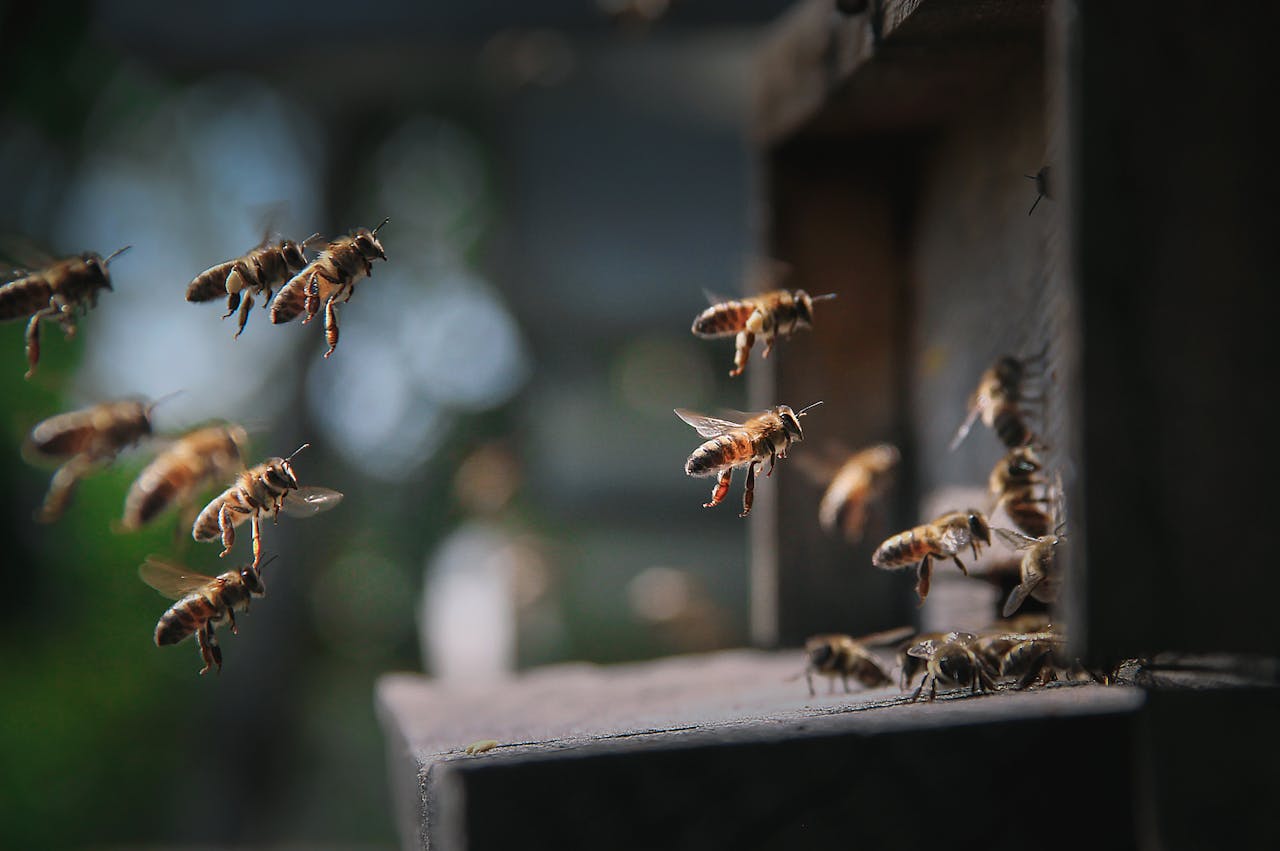
About three-quarters of the world’s leading food crops depend, at least in part, on animal pollination — and the overwhelming majority of those pollinators are insects. Apples, almonds, blueberries, mangoes, avocados, squash, coffee, cocoa, and countless others are not gifts of human ingenuity alone. They are negotiated daily between a flower and a bee, a fig and a wasp, a cacao bloom and a midge no bigger than a grain of pepper. Take away the insect, and the negotiation fails. The flower closes. The fruit never forms. The grocery aisle goes thin.
What the Nepalese study has done, for the first time in this kind of granular detail, is put a human face on what economists like to call “ecosystem services.” In those ten villages, wild pollinators delivered:
- 44% of farming income — nearly half of what families earned to live on.
- Over 20% of vitamin A, vitamin E, and folate intake — nutrients without which children go blind, pregnancies go wrong, and brains do not fully form.
- A measurable share of the difference between a household that thrives and a household that watches its children fail to grow.
And here is the climate justice cut, the one that should sit heavy in every policymaker’s chest: the communities contributing the least to the drivers of this collapse are the first to pay for it. They did not build the industrial pesticide regimes. They did not lay down the monocultures stretching to the horizon. They did not pour the emissions that are now scrambling flowering times and pushing pollinators past their thermal limits. They simply farmed, the way their grandparents farmed, in landscapes that depended on the small winged workforce showing up. The workforce stopped showing up. The children are paying.
Roughly two billion people worldwide depend on smallholder farming like this. Two billion. That is not a fringe statistic. That is one in four humans alive on Earth. If pollinator decline continues unchecked, the Nature researchers project a 7% drop in vitamin A and folate intake by 2030 in these communities — enough, in real bodies, to mean more childhood blindness, more neural tube defects, more stunted lives. Seven percent sounds small until you realize it is being subtracted from people who had no margin to begin with.
And let no reader in a wealthier country exhale here. The same pollinator collapse is unfolding in California’s almond orchards, in European apple belts, in the wildflower margins of the American Midwest. The Nepalese children are the canary. We are all in the mine.
The crises are not separate. They are conspiring.
If you only remember one thing from this post, let it be this: the insect collapse is not a standalone tragedy. It is the meeting point of every major ecological emergency we are living through, all converging on the same six-legged victims.
Consider what insects are being asked to survive, simultaneously:
Climate breakdown. Heatwaves are pushing bees past the temperatures at which they can forage. Droughts are wilting the wildflowers they depend on. Erratic springs are decoupling the ancient calendar between when a flower blooms and when its pollinator wakes up — a phenomenon ecologists call phenological mismatch, and it is exactly as catastrophic as it sounds. A strong El Niño year — like the one currently rewriting weather across the Pacific — adds another shove to a system already staggering.
Industrial agriculture. Vast monocultures of corn, soy, and wheat have replaced the messy, flowering, hedgerow-stitched landscapes pollinators evolved with. We have created what ecologists call “green deserts” — fields that look lush from a car window but are, from a bee’s-eye view, food deserts soaked in neurotoxins. Neonicotinoid pesticides, applied at industrial scale, impair insect navigation, memory, and reproduction at doses far below what was once considered safe.
Habitat erasure. Roads, suburbs, parking lots, and lawn-obsessed monocultures of grass have paved over the wildflower meadows, the dead wood, the leaf litter, the muddy puddles — the unglamorous, “untidy” spaces where insects actually live.
Pollution beyond pesticides. Microplastics are now found in insect tissues, in the air they fly through, in the rain that falls on their nests. Light pollution disorients moths and confuses fireflies. Atmospheric nitrogen deposition is rewriting the plant communities they depend on.
Any one of these would stress a population. All of them at once is what scientists mean when they whisper about tipping points — thresholds below which an ecosystem stops degrading gracefully and starts unraveling fast. We do not know exactly where that threshold sits for global pollinators. We know we are getting closer to it every year. And we know that on the other side of it, the food system we have built on the backs of insects becomes a system we cannot afford.
This is why the climate emergency and the biodiversity emergency are the same emergency, wearing two faces. We are eroding the safety net that makes every harvest possible, one insect at a time.
What we do now still matters. Here is the leverage.
If this post stopped here, it would be doom — and doom is a lie, because doom forecloses on the future before the future has finished arguing back. So let us be precise about what works.
The Nature study did not just document the wound. It modeled the medicine. In the same Nepalese villages, the researchers tested what would happen if communities adopted a few unglamorous, well-known, pollinator-friendly practices:
- Planting native wildflowers along field edges and between crops.
- Protecting wild bee habitat — keeping the hedgerows, the deadwood, the messy margins where pollinators actually nest.
- Reducing pesticide use, especially the broad-spectrum applications that kill far more than their intended target.
The result of those modest changes, in the model: farm incomes up by as much as 30%. Vitamin A intake up 5%. Folate intake up 9%. Children fed. Pregnancies safer. Eyes that see. From planting wildflowers. This is the part nobody tells you about the climate and biodiversity emergencies — that the cheapest, oldest, most boringly effective interventions are sitting right there, waiting for someone to give the order.
So here is the order, for each of you reading:
Parents. Plant something that flowers, even if it is one pot on a fire escape. Let the dandelions live. Teach your children that the bee on the basil is not a threat to be sprayed but a worker on whom their dinner depends. Ask your school district whether the lawn is being treated with neonicotinoids — and what it would take to stop.
Educators. Bring this study into the classroom. Connect the dots between a Nepalese child’s growth chart and the cocoa in a candy bar. Let the next generation grow up understanding that biodiversity is not decoration — it is infrastructure, as essential as roads and water mains, and currently in worse repair than either.
Policymakers. Stop treating pollinator protection as an optional garnish on agricultural policy. Integrate it into national nutrition strategies, climate adaptation plans, farm subsidies, and pesticide regulations. Ban what needs banning. Fund what needs funding. The economics are unambiguous: protecting pollinators is cheaper than the malnutrition, crop failure, and pollination-by-hand that follows their absence. China’s Sichuan apple farmers, who now pollinate trees with feather brushes because the bees are gone, are not a curiosity — they are a preview.
Younger readers, the ones who will inherit the math. Your generation did not break this system, but you will be asked to live inside the consequences. The good news, the real news, is that the levers are still in reach. Vote like it. Eat like it. Garden like it. Organize like it. And refuse — refuse — the comfortable lie that nothing can be done.
A love letter we are still allowed to answer
Here is the truth we cannot keep tucked into footnotes: every almond on your counter, every coffee in your hand, every cocoa bar in a child’s lunchbox is a love letter from an insect to a human — and we are burning the post office.
Three-quarters of the world’s crops depend on these tiny pollinators, and about two billion people — smallholder farmers, the people who feed the rest of us — sit closest to the cliff edge. But despair is a luxury we can’t afford, because the same study showed that simple, ancient acts of stewardship — planting native wildflowers near fields, protecting wild bees, cutting pesticide use — could lift farm incomes by up to 30% and measurably restore the nutrients in children’s diets.
Parents, plant. Educators, teach this. Policymakers, legislate as though your grandchildren’s eyesight depends on it — because it does.
And if you feel the weight of this and don’t know where to put it down, come find us. We’ve built a dedicated space for exactly this work at Climate Tribe Social — a community for the concerned, the curious, and the unwilling-to-look-away, where adaptive resiliency is not a slogan but a daily practice of dialogue, learning, and collective action.
The insects can’t speak for themselves. We can. Let’s.
✦ ✦ ✦
“The Earth is what we all have in common.” — Wendell Berry, The Unsettling of America: Culture & Agriculture (1977)
✦ ✦ ✦
🌍 Sources
Timberlake, T. P., et al. “Pollinators support the nutrition and income of vulnerable communities.” Nature (May 2026). DOI: 10.1038/s41586-026-10421-x.
Hallmann, C. A., et al. “More than 75 percent decline over 27 years in total flying insect biomass in protected areas.” PLOS ONE (2017).
Sánchez-Bayo, F. & Wyckhuys, K. A. G. “Worldwide decline of the entomofauna: A review of its drivers.” Biological Conservation (2019).
Thompson, J. “‘Insect apocalypse’ is already fueling malnutrition in some regions.” Live Science (May 11, 2026).