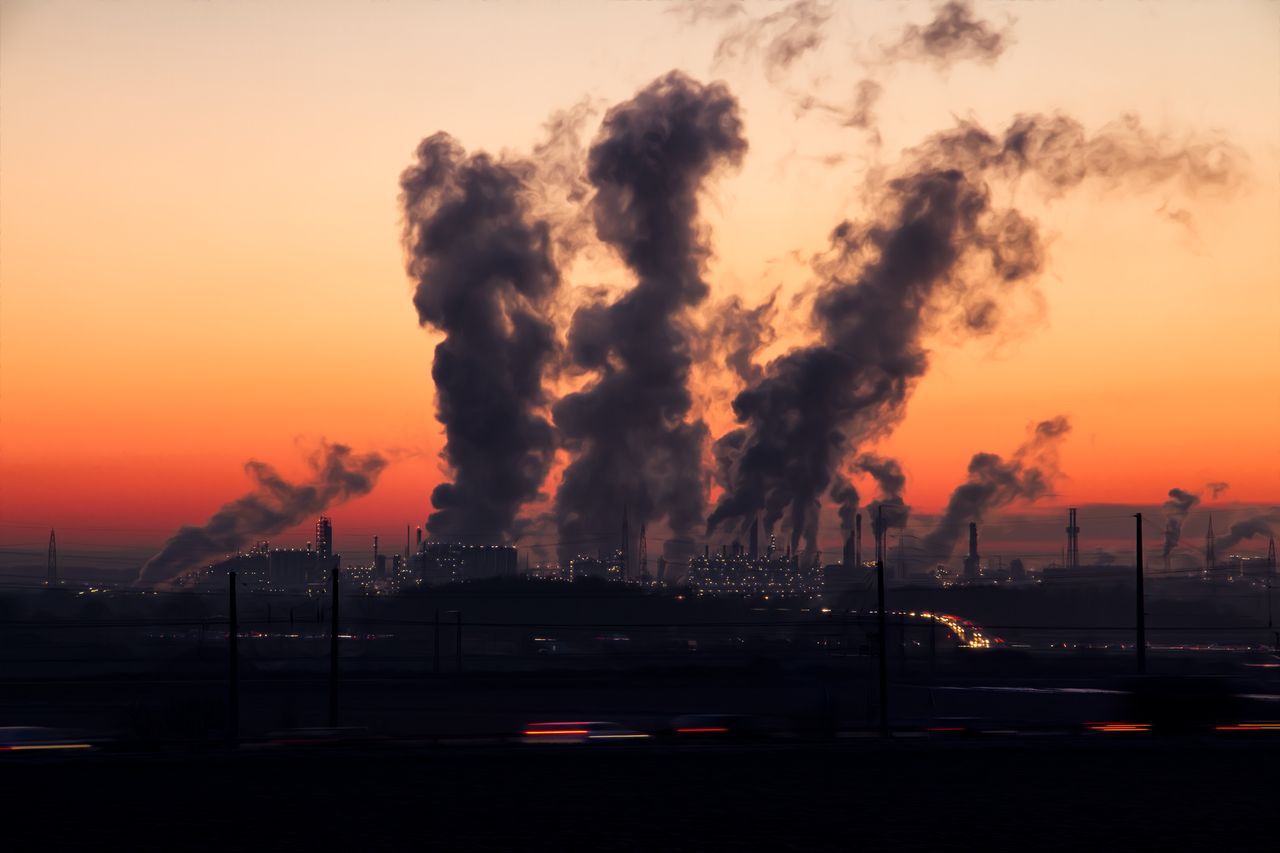
The Crisis Was Never an Accident: How They Knew, How They Lied, and Why It’s Time to Vote Them Out
Revisiting a 2021 warning — and confronting how little has changed.
A few years ago I read an article that has never quite left me. It was published in January 2021 on Below2C, written by Brad Zarnett, titled “Ethically Bankrupt Politicians Are Killing The Planet.” It opened with a conversation between Zarnett and his colleague Magnus L.H. Haslebo — co-founder of the resistance group Guerilla and former head of communications for Denmark’s political party The Alternative — and it landed on a single, uncomfortable conclusion.
While corporate greed is what destroys the planet, it is political complicity that paves the road.
I keep returning to that article because of a feeling I cannot shake. When I read it now — years later, in a world that has only grown hotter — it does not read like a relic. It reads like it was written this morning. The dates have changed. The warnings have not. And that, more than any single statistic, is the thing I need you to sit with.
Because here is the truth that should disturb every one of us: the climate crisis was never an accident. It was not a tragic oversight, a failure of imagination, or a problem nobody saw coming. It was foreseen with precision, documented in private, denied in public, and protected by politicians who were paid — directly and openly — to look away.
This is the story of how that happened. And why the most powerful tool we still hold against it is the ballot.
They Knew. They Always Knew.
Let’s begin where the deception begins — not with politics, but with science the public was never allowed to see.
As early as the 1950s, the fossil fuel industry understood that burning its product warmed the planet. By the late 1970s, that understanding was not vague. It was quantitative.
In 2023, researchers at Harvard University and the Potsdam Institute for Climate Impact Research published the first systematic assessment of the fossil fuel industry’s own climate modeling in the journal Science. They examined internal documents and peer-reviewed work produced by Exxon and ExxonMobil scientists between 1977 and 2003. What they found should be taught in every classroom on Earth.
Between 63% and 83% of the climate projections Exxon’s own scientists made were accurate. Their models correctly predicted that the planet would warm by roughly 0.2°C per decade — a forecast that matched, and sometimes exceeded, the work of independent academics and government agencies. Lead author Geoffrey Supran called it the “smoking gun.” Co-author Naomi Oreskes, a Harvard historian of science, described the precision as “astonishing” — and the hypocrisy as worse, because the very company producing this excellent science spent decades publicly insisting that climate models were unreliable.
A 1980 internal Exxon memo even proposed a public-relations plan to gain “national recognition” for its CO2 research — noting candidly that future public decisions to limit CO2 “could impose limits on fossil fuel combustion.” Translation: we understand exactly what the science means for our profits.
They didn’t just know “something.” They knew everything that mattered. And they chose to bury it.
The Tobacco Playbook: Manufacturing Doubt
Knowing is one thing. What the industry did next is what makes this a story of moral collapse rather than mere negligence.
Instead of warning the world, the fossil fuel industry funded confusion. It borrowed, almost line for line, the strategy the tobacco industry had used to delay regulation for decades: you do not need to win the science, you only need to make the public believe the science is unsettled.
Throughout the 1980s and 1990s, oil and gas interests poured money into a machine of doubt. The Global Climate Coalition — which counted Exxon and Mobil among its active members — campaigned aggressively against climate regulation. In 1997, a coalition-sponsored effort ran an estimated $13 million advertising blitz against the Kyoto Protocol.
Then came the document that strips away any remaining illusion of good faith. In 1998, the American Petroleum Institute drafted the Global Climate Science Communications Action Plan — now infamous as the “Victory” memo. Developed with contributors from Exxon, Chevron, and conservative front groups, it was leaked to The New York Times that same year. Its objective was stated without shame:
“Victory will be achieved when average citizens ‘understand’ (recognize) uncertainties in climate science.”
Read that again. Victory. Not a cleaner planet. Not a safer future for children. Victory was a public too confused to demand action. The memo laid out how to manipulate journalists, manufacture a false “both sides” debate, and paint those who accepted the scientific consensus as “out of touch with reality.”
Over the years, ExxonMobil alone funneled an estimated $23 million to organizations whose purpose was to undermine climate science. This was not ignorance. It was strategy. It was a campaign — and the target was your understanding of reality.
The Political Machinery of Delay
Disinformation, on its own, does not stop laws from being passed. For that, the industry needed something more reliable than confused citizens. It needed the lawmakers themselves.
The seventeenth-century philosopher John Locke gave us a principle that still defines legitimate government: power is held under a social contract. Citizens transfer some of their rights to a government on the condition that the government protects the public good. When a government persistently fails to protect its people from a known, existential threat, its legitimacy begins to dissolve.
That is precisely where decades of fossil fuel political capture have brought us. The mechanics are not hidden — they are matters of public record:
- Campaign financing tied directly to fossil fuel interests, flowing to candidates with a proven record of voting the industry’s way.
- Regulatory capture, where the officials meant to oversee an industry are staffed, funded, or persuaded by it.
- Climate targets engineered for optics — ambitious-sounding language designed to require almost nothing.
And this is not abstract history. In the 2024 U.S. election cycle, the fossil fuel industry’s financial influence reached staggering levels. An analysis by Climate Power estimated that oil and gas interests spent roughly $445 million to shape the election and the incoming Congress. A record $96 million went to one presidential campaign and its affiliated political committees. The industry spent $243 million lobbying Congress over the cycle. Open Secrets data showed that 88% of oil and gas money flowed to a single party.
That investment has terms. It always has. In the months that followed, federal climate regulations faced rollback after rollback — culminating in moves to repeal the government’s “endangerment finding,” the formal scientific acknowledgment that greenhouse gases endanger public health. A congressional investigation into the industry’s own history of climate disinformation was quietly halted.
This is the throughline. From the Victory memo of 1998 to the campaign checks of 2024, the strategy has never changed: buy the policy, delay the transition, protect the profit.
The Illusion of Progress: From Paris to “Net Zero”
If the industry’s influence were obvious, citizens would revolt. So the deeper trick has always been to make inaction look like progress.
The 2015 Paris Agreement was hailed as a turning point. Nearly every nation pledged to hold warming “well below” 2°C, ideally 1.5°C. But the agreement was non-binding, had no enforcement, and let each country set its own targets. As the Below2C article put it bluntly, it was a politician’s dream — a chance to stand on the world stage and bask in “leadership” without making a single difficult decision.
By 2020, nearly every major economy was off track. And because everyone failed together, no one could be singled out. Zarnett gave this phenomenon a name that has stayed with me: “immunity via collective failure.”
The same sleight of hand now surrounds “2050 net zero.” It sounds responsible. It sounds ambitious. But it is routinely stripped of the one fact that gives it meaning.
The IPCC is unambiguous: to stay within 1.5°C, global emissions must fall roughly 45% from 2010 levels by 2030, on the way to net zero by 2050. The 2030 milestone and the 2050 goal are not alternatives. They are a single, linear path — you reach 2050 through 2030 or you do not reach it at all.
Yet politicians spotlight the distant, comfortable date of 2050 while quietly omitting the urgent one. That omission is not a technicality. It is, as the original article called it, “lying by omission” — a deliberate reshaping of public perception that buys the status quo another decade.
Where We Actually Stand in 2026
So has any of this — the science, the warnings, the decades of pressure — actually moved the needle? Look honestly at the numbers, and the answer is brutal.
2024 became the first calendar year in which global average temperatures reached roughly 1.5°C above pre-industrial levels. Global greenhouse gas emissions hit a record — about 57.7 billion tonnes of CO2 equivalent, an all-time high.
The UN Environment Programme’s Emissions Gap Report 2025 carries a title that needs no interpretation: Off Target. It found that the latest round of national climate pledges has only slightly lowered projected warming, leaving the world heading toward a serious escalation of climate risk. A temporary overshoot of 1.5°C is now considered very likely within the next decade.
And here is the line from that report that should be printed on the wall of every legislature on Earth: the gap between what is needed and what is being done reflects a lack of political will — not a lack of technical capacity. We can cut emissions. The solar panels exist. The wind turbines exist. The grid technology exists. What is missing is not the means. What is missing is leadership willing to defy the donors.
How Little Has Changed — And Why That Is the Real Story
Step back and look at the full arc, from the 1970s to this moment.
- The science got clearer.
- The impacts got more visible — the fires, the floods, the records falling year after year.
- The warnings got louder.
And against all of that:
- Fossil fuel expansion continued.
- Political timelines stayed misaligned with physical reality.
- Corporate influence over policy grew more entrenched, not less.
The tactics evolved. The sophistication increased. A 2021 article reads like a 2026 headline because the underlying machine — delay meaningful action while protecting profit — has simply kept running. We have spent fifty years not failing to understand the problem. We have spent fifty years being prevented from acting on it.
That is the discovery I cannot un-see. The most shocking thing about the climate crisis is not how much has changed. It is how little.
Adaptive Resiliency: Why This Is Not a Story of Despair
I do not write any of this to crush you. I write it because clear sight is the first act of resistance.
Despair is what the machine wants. A confused public was the goal of the Victory memo; an exhausted, hopeless public is its sequel. If you believe nothing can change, you will not vote, you will not organize, you will not show up — and that is precisely the outcome a half-century of disinformation was engineered to produce.
This is where Adaptive Resiliency becomes our answer. It is the framework I return to in all of this work: communities confronting the Climate and Ecological Emergency not as passive victims but as active participants — through collaboration, cooperation, honest dialogue, and the intelligent use of every tool available to us, including AI. Adaptive Resiliency refuses two false comforts at once: the comfort of denial, and the comfort of surrender.
It says: Yes, the system has been captured. And no, that capture is not permanent. Systems built by human choices can be unbuilt by human choices. The same physics that does not negotiate also does not lie — and the truth, once enough people hold it together, is a force the donor class has never been able to buy.
The Turning Point: Your Vote Is the One Thing They Can’t Purchase
Here is what fifty years of evidence finally narrows down to.
Voting is not a symbolic gesture. It is one of the very few mechanisms ordinary people still hold that the fossil fuel industry cannot directly buy. They can fund a campaign. They can write the talking points. They can lobby until midnight. But they cannot cast your ballot for you.
That is the leverage. And to use it well, Adaptive Resiliency asks us to vote not with slogans, but with scrutiny:
- Follow the money. Before you support a candidate, ask who funds them. Campaign finance is public. A politician’s donors tell you more about their future votes than any speech ever will.
- Measure words against science, not against messaging. A candidate who celebrates “2050 net zero” but cannot speak to the 2030 milestone is telling you something. Listen for the omission.
- Support leaders willing to disrupt the pattern, not manage it. We do not need climate policy that is “realistic” by the donor class’s definition of realistic. We need leaders who treat the 2030 timeline as non-negotiable — because physics already has.
People are tired. Tired of the lies. Tired of political theater performed by those who enter public office to enrich themselves or to consolidate power. That exhaustion is justified — but it must not become withdrawal. The antidote to manipulation is not cynicism. It is participation, made sharper by everything we now know.
A Choice, Not a Fate
The historical record is clear. When profit and planetary survival have been placed in conflict, the systems we built have, again and again, chosen profit. The fossil fuel industry knew the truth, sold the doubt, bought the politicians, and ran out the clock — and our children are now inheriting the bill.
But a pattern is not a prophecy. A pattern is a choice made repeatedly — which means a different choice remains available every single time we are asked.
The climate crisis is not, at its core, an environmental issue. It is a governance issue. It is a question of whether democratic power can break free of the interests that have constrained it for five decades.
We are no longer in an age of uncertainty. The science is settled. The solutions exist. What remains undecided is only this: whether we will elect leaders who place the survival of people and the living world above the lining of their own pockets.
Physics does not negotiate. Ecosystems do not wait. And time, unlike a politician’s promise, cannot be extended.
The question was never whether we understand the problem.
The question is whether we are finally willing to act on that understanding — and to demand, with our votes and our voices, that those in power do the same.
Vote like the future is watching.
Because it is.
Sources & Further Reading
- Brad Zarnett, “Ethically Bankrupt Politicians Are Killing The Planet,” Below2C, January 2021 — below2c.org/2021/01/ethically-bankrupt-politicians-are-killing-the-planet/
- Supran, Rahmstorf & Oreskes, “Assessing ExxonMobil’s global warming projections,” Science, 2023 — science.org/doi/10.1126/science.abk0063
- Harvard / Potsdam Institute press release on the Exxon projections study — pik-potsdam.de
- “Exxon Sowed Doubt About Climate Science for Decades,” Inside Climate News — insideclimatenews.org
- American Petroleum Institute, Global Climate Science Communications Action Plan (the 1998 “Victory” memo), as reported by The New York Times, PBS NewsHour, and Scientific American
- Climate Power, “Oil and Gas Industry Spent $450 Million to Influence Trump and the 119th Congress,” 2025 — climatepower.us
- Yale Climate Connections, “The fossil fuel industry spent $219 million to elect the new U.S. government,” January 2025
- Brennan Center for Justice, “Fossil Fuel Industry Donors See Major Returns in Trump’s Policies,” 2025
- UN Environment Programme, Emissions Gap Report 2025: Off Target — unep.org/resources/emissions-gap-report-2025
- IPCC, Special Report on Global Warming of 1.5°C — Summary for Policymakers
This article is part of an ongoing series exploring the Climate and Ecological Emergency through the lens of Adaptive Resiliency — collaboration, cooperation, dialogue, and collective action as our path forward.