The Forgotten History of April 22 — and Why It Matters More Than Ever
A message to the generation that will inherit this planet — and every generation still fighting for it.
Here is something almost nobody will tell you today, on Earth Day.
Before 1970, a factory in the United States could legally pour tons of toxic sludge into the river running past your school. It could blacken the sky above your neighborhood with smoke so thick you could taste it. And if you tried to stop them — in court, on the street, at city hall — you would lose. Not because you were wrong. Because there was no law to break. No Clean Air Act. No Clean Water Act. No Endangered Species Act. No Environmental Protection Agency. Pollution was not a crime. It was considered a sign of progress.
That is the world Earth Day was born into. And the story of how one single day cracked that world open — and how a generation of young people did most of the cracking — is one of the most radical, surprising, and intentionally buried stories in modern history.
You deserve to know it. Because we are living through another moment when the rules need to be broken.
The Rivers Were on Fire
In June 1969, the Cuyahoga River in Cleveland caught fire. Not metaphorically. Literally. The water itself — coated in oil, chemicals, and industrial waste — burned. It was not even the first time. The Cuyahoga had been catching fire on and off since the 1800s. People had simply accepted it.
Six months earlier, off the coast of Santa Barbara, a Union Oil drilling platform blew out and vomited roughly three million gallons of crude oil across 35 miles of Pacific coastline. Seabirds drowned in black sludge. Dolphins washed up dead. A U.S. senator from Wisconsin named Gaylord Nelson flew out to see it with his own eyes — and something in him broke open.
He had been trying, for years, to get Congress to take the environment seriously. Nothing worked. Meanwhile, across American college campuses, young people were running “teach-ins” to protest the Vietnam War — all-night sessions where students, professors, and organizers packed auditoriums to learn, argue, and organize. Nelson looked at the oil-slicked water and at those packed auditoriums and had one idea: what if we did that — but for the planet?
April 22 Was Picked for a Reason
Here is a fact almost nobody knows: April 22 was not chosen because of some cosmic alignment or spiritual significance. It was chosen because it fell between spring break and final exams — the exact window when the maximum number of college students would be on campus and free to mobilize. It was a tactical scheduling decision. Nelson and the young organizer he hired, 25-year-old Denis Hayes, understood something their opponents did not: if you want to change a country, start with the young people, and meet them where they already are.
(There was also, absurdly, a conspiracy theory at the time that the date was chosen because it happened to be Vladimir Lenin’s 100th birthday. A Georgia politician actually sent telegrams warning that Earth Day was a Soviet plot. The John Birch Society pushed the same line. It tells you everything about how threatened the establishment was that they reached for red-scare paranoia against people who wanted clean water.)
The name itself — “Earth Day” — was coined by a New York advertising copywriter named Julian Koenig. His birthday happened to be April 22. He thought that made the name “logical.” A holiday born from a pun.
The Number That Should Shock You
On April 22, 1970, roughly 20 million Americans — about 10% of the entire U.S. population at the time — walked out of their schools, their offices, their homes, and into the streets.
Let that number land for a second. Ten percent. Of the entire country. In a single day. Without the internet. Without social media. Without cell phones. Organized on landlines, mimeograph machines, and by word of mouth.
It was the largest civic demonstration in American history. Manhattan’s Fifth Avenue was shut down. A quarter-million people flooded it. In Miami, activists mocked the Orange Bowl Parade with a “Dead Orange Parade.” In Berkeley, students buried a car on campus as a protest against “ecologically insane behavior.” At the University of Michigan, 50,000 people packed Crisler Arena for a four-day teach-in that featured the cast of the Broadway musical Hair and folk singer Gordon Lightfoot. A New York City college student, wearing a gas mask, “smelled” a magnolia blossom in a City Hall Park photo that would become iconic.
PBS — then called National Educational Television — devoted its entire programming day on April 22 to Earth Day. That included Sesame Street. That included Mister Rogers’ Neighborhood. An entire country’s children’s television was handed over to the planet for a day.
Even Sports Illustrated ran a cover story on the environment.
The Secret Funder: A Union Boss
Here is a piece of history almost always left out of the Earth Day story, and it tells you something important about who actually makes movements work.
The young organizers running Earth Day had almost no money. What tipped the scales was a man named Walter Reuther — the president of the United Auto Workers union. Reuther quietly gave the Earth Day team the budget for a toll-free 800 number so regional organizers across the country could call in and coordinate. He also provided key operational backing. Without that union money, Earth Day might have been a dozen scattered rallies instead of a nationwide earthquake.
Think about that. The modern environmental movement was midwifed, in part, by autoworkers. Not oil executives. Not billionaires. Working-class people who built the machines that polluted the air, who wanted cleaner air for their own kids.
The Earth Day staff themselves earned a flat $375 a month — around $3,300 in today’s money. They were broke. And they changed the world.
The “Dirty Dozen” — When Environmentalists Learned to Fight
Here is the part of Earth Day history that has been most thoroughly scrubbed from the polite telling: the original Earth Day movement went after politicians and took them down.
In the months after April 22, 1970, a new group called Environmental Action compiled a list of twelve sitting members of Congress with the worst environmental records. They called them the Dirty Dozen. With a war chest of just $50,000 — a rounding error in political money — they targeted these twelve for defeat in the November 1970 midterm elections.
Seven of the twelve lost their seats. Including George Fallon, the chairman of the powerful House Public Works Committee. The New York Times wrote that a new ingredient had been added to American elections: a candidate’s environmental record.
Congress got the message fast. Within weeks, the Clean Air Act passed the Senate on a unanimous voice vote. It passed the House with exactly one dissenting vote. The industries that had spent decades blocking environmental legislation — coal, oil, auto, steel, electric utilities — suddenly could not stop it. Because Congress was terrified of the Dirty Dozen.
Two more Dirty Dozen campaigns followed, in 1972 and 1974. A total of twenty more polluter-aligned members of Congress were voted out. In five years, a movement that started as a teach-in rewired the entire political calculus of American environmental policy.
This is what “Our Power, Our Planet” — the theme of Earth Day 2026 — actually means, historically. Not hashtags. Not tote bags. Organized, disciplined, electoral consequences for people in power who side against life.
What Earth Day Built — In Less Than a Decade
Between the first Earth Day in April 1970 and the end of that decade, the United States passed:
- The National Environmental Policy Act
- The Clean Air Act
- The Clean Water Act
- The Endangered Species Act
- The Safe Drinking Water Act
- The Resource Conservation and Recovery Act
- The Toxic Substances Control Act
- The Occupational Safety and Health Act
- The Marine Mammal Protection Act
- The creation of the Environmental Protection Agency itself, by executive order in December 1970
More environmental law was passed in the few years after the first Earth Day than in any comparable period in U.S. history — and all of it was signed by a conservative Republican president, Richard Nixon. Environmentalism was not a left/right issue. It was a survival issue. Republicans, Democrats, farmers, factory workers, church groups, scientists, grandmothers, and high school kids all showed up on the same side.
That political alignment seems almost unthinkable now. But it happened. It is on the historical record. It means it can happen again.
The Things They Don’t Tell You in School
A few more pieces of Earth Day history that are rarely taught:
The Earthrise photo changed everything. In December 1968, Apollo 8 astronaut William Anders took a color photograph of the Earth rising over the lunar horizon. It was the first time humanity had seen its own home from space — small, fragile, blue, alone. That image went around the world and lodged in the collective psyche. Senator Nelson later said it transformed how people thought about the planet. Without Earthrise, there might not have been an Earth Day.
The teach-in idea did not even start with Nelson. Months before the national Earth Day, a small group of graduate students at the University of Michigan — led by a student named Doug Scott — were already planning their own environmental teach-in for March 1970. When Nelson’s team and the Michigan students realized they were building the same thing, they joined forces. Historians now call the Michigan event “the most famous little-known event in American history.”
Earth Day was not originally one day. It was a season. In many cities, events ran for a full week. At the University of Michigan, they lasted four days. Historian Adam Rome has argued the event should really be called “Earth Spring.” The “single day” framing came later — and it may have been Earth Day’s greatest weakness, because it let the movement become a calendar entry instead of a permanent pressure campaign.
The first Earth Day organizers were almost all in their twenties. Denis Hayes was 25. The regional coordinators he hired were in their twenties. Almost none of them had any prior environmental experience — they came from the anti-war movement, the civil rights movement, the women’s liberation movement. They brought the tactics of one fight to a fight that had not yet learned how to fight.
Early Earth Day events connected everything to everything. Freeway construction. Pesticides. Agent Orange used in Vietnam. Lead paint poisoning in low-income housing. Nuclear weapons testing. Overpopulation. Environmental racism (though they did not yet call it that). From the very first day, the movement understood — in a way we still struggle to articulate — that you cannot separate ecology from justice, from war, from poverty, from public health. They are one fabric.
The Weight of 2026
Here is where the story stops being about history and starts being about you.
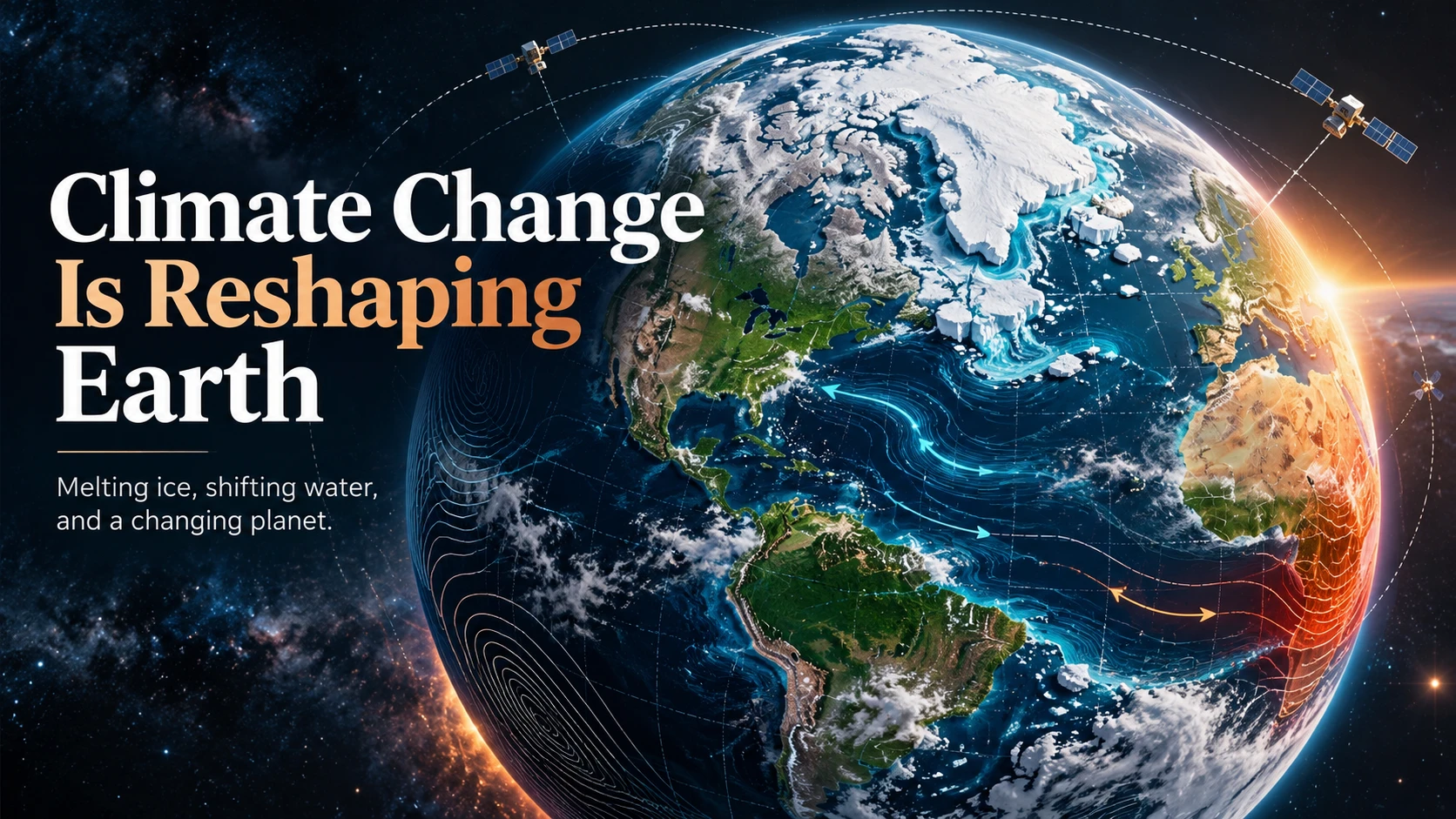
When Earth Day began in 1970, there were about 3.7 billion people on Earth. Today, there are more than 8 billion. Back then, atmospheric CO₂ was around 325 parts per million. Today, we have crossed 420. Back then, the climate crisis was a theoretical concern raised by a few scientists. Today, it is a declared emergency — written into the language of the United Nations, the World Health Organization, and thousands of local governments.
We are watching heat records shattered year after year. Aquifers drained. Coral reefs bleached. Forests reduced to kindling. Rivers — including the Colorado, the Euphrates, the Rhine — running so low they can no longer do what civilizations built themselves around them to do. Species disappearing at rates not seen since the asteroid. Climate migration beginning. Oceans warming and acidifying. And the fossil fuel industry still — still — planning to extract and burn enough carbon to render much of this planet uninhabitable for the people reading this sentence.
The young people of 1970 faced burning rivers and oil-slicked coasts. Those were visible, local wounds. The young people of 2026 face a wound that is planetary, systemic, and still accelerating. Your task is harder. And your time is shorter.
But here is what the history of Earth Day tells you, plainly and without hedging: ordinary people, organized and unafraid, have rewritten the rules of entire civilizations before. In less than a decade. With almost no money. Against every powerful industry of their time.
Quotes to Carry With You
“The greatest threat to our planet is the belief that someone else will save it.”
— Robert Swan
“We are the first generation to feel the impact of climate change and the last generation that can do something about it.”
— Barack Obama
“If every day were Earth Day, we wouldn’t be in the mess we’re in.”
— Neil deGrasse Tyson
“We are living on this planet as if we had another one to go to.”
— Terri Swearingen
“Life is a chain. All things are related. When any link is harmed, the other links are affected.”
— Daisaku Ikeda
“Never doubt that a small group of thoughtful, committed citizens can change the world; indeed, it’s the only thing that ever has.”
— Margaret Mead
And one more, from Denis Hayes himself — the 25-year-old who coordinated the original Earth Day, speaking now as an elder looking at 2026:
“All those years ago, in 1970, we were ridiculously confident that we were going to win. We launched a genuine environmental revolution. We proved that an engaged public can be an unstoppable force. It can be again in 2026.”
— Denis Hayes
What Earth Day Asks of You — Tomorrow, and Every Day After
The 2026 theme is Our Power, Our Planet. Read that carefully. It does not say their power. It does not say the government’s planet. It says ours. Yours. Mine. The kid down the block. The farmer. The nurse. The student with a phone and an opinion. The generation that inherited a debt it did not run up.
What you can do, starting tomorrow, is not small — even when it feels small:
Learn your own Dirty Dozen. Find out who in your local, state, and national government is voting against the future. Not to hate them. To replace them. The 1970 generation did it with $50,000 and index cards. You have better tools.
Find your threads, and weave them. Denis Hayes said the genius of Earth Day was taking people who cared about birds, and people who cared about oil spills, and people who cared about lead paint, and showing them they were all in the same fight. Your climate fight, your housing fight, your labor fight, your justice fight, your Indigenous-rights fight, your food-justice fight — they are one fabric. Weave them.
Refuse the “single day” trap. Earth Day only works if it is a launchpad, not a holiday. Plant something. Show up to a meeting. Speak at a hearing. Organize your block. Refuse to go back to sleep on April 23.
Reject eco-perfectionism. The 1970 movement did not demand moral purity before it let you in. Farmers, Republicans, union members, suburban housewives, and radical students all showed up and did not agree on everything. They agreed on one thing: we are not going to let them poison the planet anymore. That was enough. It can be enough now.
Tell the real history. The version of Earth Day most people are taught is a sanitized, corporate-friendly, bring-a-reusable-mug version. The actual story is more radical and more useful: teach-ins, electoral warfare, union money, underground student newspapers, banned high school publications, cars put on trial, politicians voted out of office. Share that story. It changes what tomorrow can mean.
A Closing, From the Record
In the spring of 1971 — one year after the first Earth Day — William D. Ruckelshaus, the very first administrator of the brand-new Environmental Protection Agency, stood up and said this:
“Last year some said there would never be another Earth Day. They saw concern for our environment as a fad, and claimed that the instant enthusiasm of an activist generation would soon flow elsewhere. I believe they were wrong.”
— William D. Ruckelshaus, 1971
He was right. They were wrong. The generation that made Earth Day did not give up, did not get bought off, did not move on. They built institutions that — however imperfectly — have saved millions of lives, prevented untold illnesses, and kept a great deal of the natural world alive long enough to be defended by you.
Now it’s your turn.
The rivers are not on fire in the same way they were in 1969. But the atmosphere is. The oceans are. The forests are. The ice is disappearing in ways the Earth has not seen in millions of years. The wound is bigger. The stakes are total.
And the same thing is still true today that was true on April 22, 1970: nobody is coming to save this planet except us.
Happy Earth Day. Make it count. Then make every day after count more.
The first Earth Day shut down Fifth Avenue. What will the next one shut down?